SUBSCRIBE


Could Times Square Look Like This in the Future?

Covid-19 has accelerated many changes. One area this can be seen in particular is in cities. Currently, roadways and buildings dominate cityscapes, with far less space dedicated to outdoor recreation, pedestrians, cyclists, scooters, etc. While the eco-conscious movement toward reducing the use of super pollutants like gas-powered cars was growing pre-Covid, especially in highly populated areas such as cities. With Covid, the need for more people-friendly streets became blatantly obvious. So what might the urban design of places like Times Square look like in the future?
As the use of traditional cars declines, the use of alternate modes of eco-friendly transportation increases. Couple this with the desire for more humancentric outdoor space, and sidewalks and roads as we know them will no longer exist. The opportunity arises for a complete reformation of the surfaces between buildings. And a fundamentally different cityscape of the future. Interested in this repurposing and new urban design, the architects at 3deluxe presented a design study called New Mobility. A study in which they explored intriguing new possibilities using Times Square as an example.

3deluxe’s Experience in Lithuania
When conceptualizing ideas for a new urban design of Times Square, 3deluxe referred to their V-Plaza project in Lithuania. The completion and opening of the plaza took place in the midst of the Covid pandemic in early summer, 2020. The open design of the square, with interwoven zones for relaxation, communication, and play, as well as areas for ways of getting around like bicycles, scooters, skates, and skateboards, has been extremely well received by the local inhabitants. As a result, over the summer the plaza swiftly evolved into a vibrant, public living space for the city.
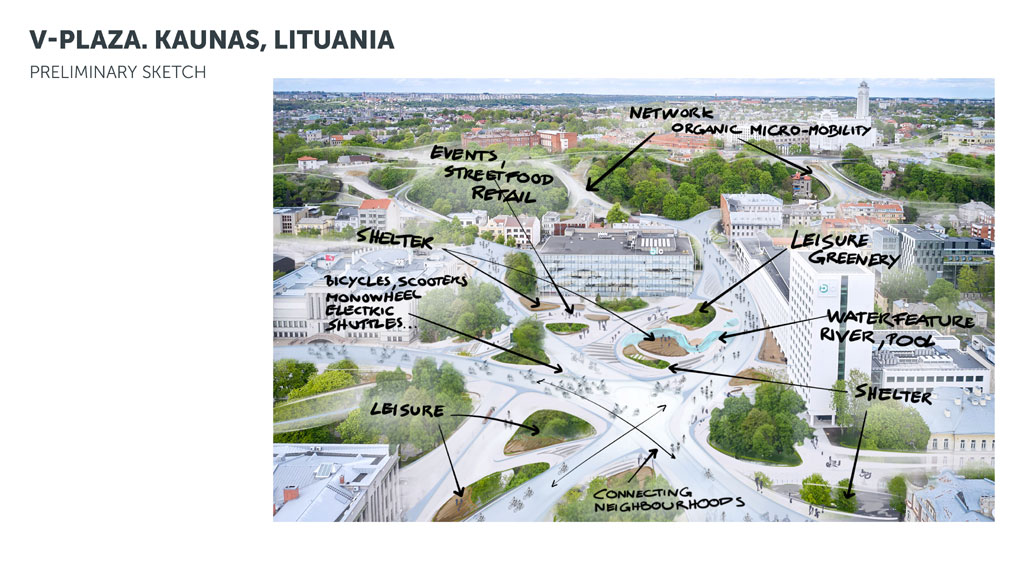

For the architects of 3deluxe, this project gave them a great opportunity to look closely at the future of city spaces free of motor vehicles. Spacious, inviting, and attractive areas for the ever-larger number of users of environmentally friendly individual mobility options in a harmonious interplay with pedestrians and those enjoying a stroll or leisure time.
The Future of the Cityscape & Urban Design
So what does the future cityscape look like? It is easy to see a future where the classic road layout is abandoned and replaced by organic urban landscapes that offer new spaces for pedestrians and modern forms of mobility.

Dynamic routes designed for smooth mobility (bicycles, scooters, skaters, inline skaters, walkers, runners, e-public transport) will be more and more frequent. There will also be zones and islands with different offerings for city dwellers outside and on foot: communicative living areas, spaces to exercise or relax, leisure areas, water resources, urban gardening, green areas, pop-up stages for cultural events, open-air breweries, pop-up stores, charging stations for electronic mobility, etc.

And perhaps this is how Times Square could look? Pretty nice we think!

Biophilic Design: The (New) Hanging Gardens of Babylon
About 3deluxe
The 3deluxe architecture department specializes in iconographic architecture and is run by Dieter Brell.
3deluxe creates sustainable architecture that expresses themes and visions. Architecture that conveys the messages that brands want to convey. And above all, architecture that produces innovation. Or simple experiences, in order to architect the world in a more beautiful way.
For more than 20 years, 3deluxe has established innovative impulses when it comes to design. More recently, its position in the world of architecture. In an international context, the company has already carried out numerous architectural projects and honored with prizes. Examples include the ‘Leonardo Glass Cube’ corporate architecture, the ‘Zeilgalerie’ redesign in Frankfurt, the ‘Kaffeepartner’ corporate headquarters, and the complete ‘Noor Island’ project in Sharjah.