SUBSCRIBE


The Quiet Luxury of Wood, Stone, and Space in a Well-Composed Bath
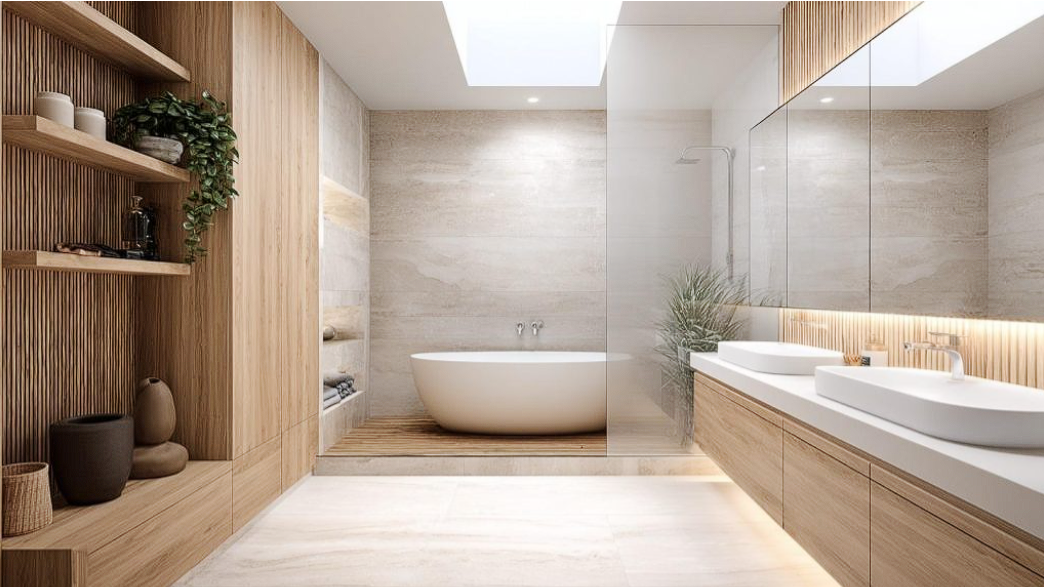
The bathrooms that linger in memory are rarely the ones trying hardest to impress. More often, they are the rooms that feel settled from the moment you step into them. The materials are beautiful, certainly, but beauty is not doing all the work. Proportion, visual pause, and a sense of ease shape the experience just as much.
That distinction matters because the bathroom carries a quiet emotional weight in daily life. It is the first room many of us meet in the morning and the last one we leave at night. A room like that should feel restorative, not merely polished. Yet plenty of well-appointed bathrooms miss the mark. They look expensive, but they do not quite feel calm. Usually, the issue is not the finish schedule. It is the composition.
Why Serenity in a Bathroom Has More to Do With Composition Than Cost
A bathroom can be filled with fine materials and still feel unsettled. That tends to happen when too many elements are asking for equal attention. A dramatic slab, a sculptural mirror, bold lighting, striking hardware, a freestanding tub with a strong silhouette. Each detail may be lovely on its own, but together they can create a room with no clear place for the eye to rest.
The most serene bathrooms have hierarchy. One or two elements carry the visual weight, while everything else supports them. That is what makes a room feel considered rather than crowded. Even in a compact bath, the eye needs a sense of order.
Negative space is part of that order. Breathing room around a vanity, open stretches of wall, and an uncluttered line of sight can change the mood of a room more than another layer of decoration ever will. This is often why a bathroom can feel expensive without feeling restful. It is finished, but not edited.
A helpful question to ask is simple: what is the room asking me to notice first? If the answer is everything, the composition may need to be pared back.
Wood Brings the Warmth That Modern Bathrooms Often Miss
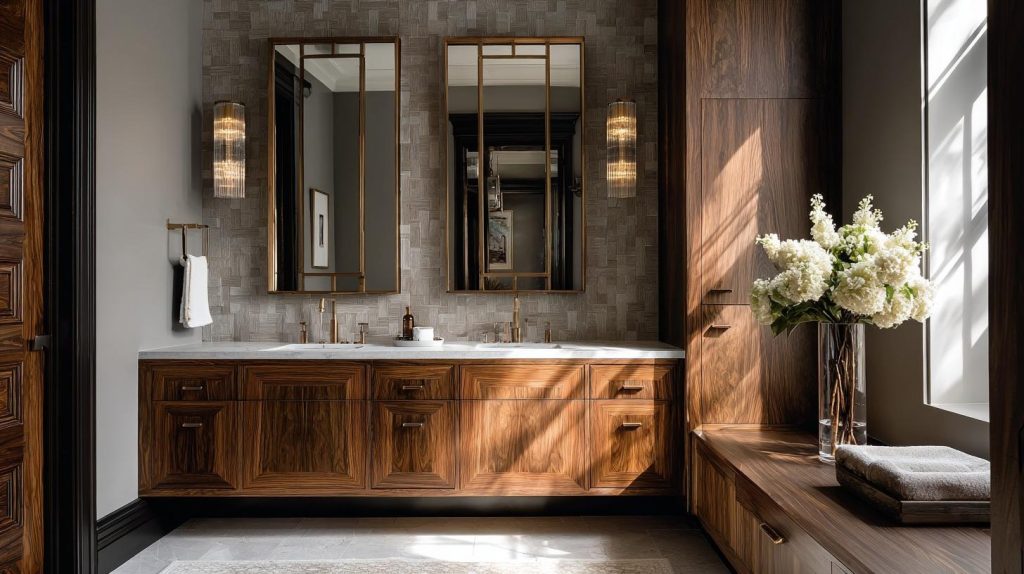
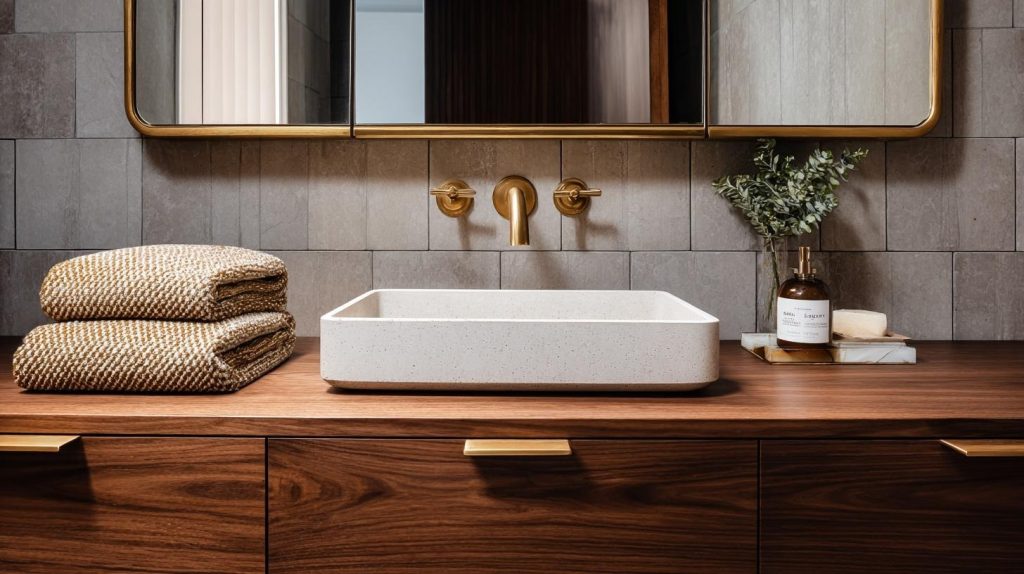
Modern bathrooms are often built from cool materials. Stone, tile, glass, and metal all bring clarity, but on their own they can tip a room into something that feels pristine rather than welcoming. Wood softens that edge.
It does so in more than one way. Warm timber introduces variation that polished surfaces cannot. Grain gives the eye somewhere gentle to land. Tone brings depth. Even in a very tailored space, wood has a way of making the room feel inhabited.
Walnut and oak are especially effective here because they add warmth without becoming fussy. They hold their own against stone, but they do not fight it. In a bathroom that is leaning too cold or too hard, that balance can make all the difference.
Furniture-like forms help as well. A vanity that feels like a real piece of furniture, rather than a box tucked under a sink, gives the room more character and a stronger sense of permanence. In that context, references such as AURA’s mid-century vanity collection make sense within a broader design conversation. The appeal is not only function. It is the quiet presence a well-shaped piece can bring to the room.
If a minimalist bathroom feels sterile, the problem is often not minimalism itself. It is the lack of tactile contrast.
Stone Should Add Quiet Depth, Not Compete for Attention
Stone brings gravity to a bathroom. It can make even a simple space feel lasting and well made. Still, stone is usually most compelling when it supports the room instead of dominating it.
The instinct to choose the boldest slab is understandable. A striking surface can be seductive in a showroom. In a finished bathroom, though, a heavily patterned stone can start to crowd the room, especially when paired with expressive wood grain, bright hardware, or layered tile.
Often, the most luxurious choice is the one with more restraint. Honed finishes tend to absorb light more softly than polished ones. Gentle veining can hold interest without adding visual noise. A countertop or wall application that leaves room for cabinetry, fixtures, or lighting to speak can create a more persuasive sense of balance.
One useful rule is to let one material do the talking. If the stone is dramatic, quiet the wood. If the wood has movement and warmth, let the stone be calmer and more architectural. A bathroom does not need every surface to announce itself.
The Difference Between a Bathroom That Feels Collected and One That Feels Overworked
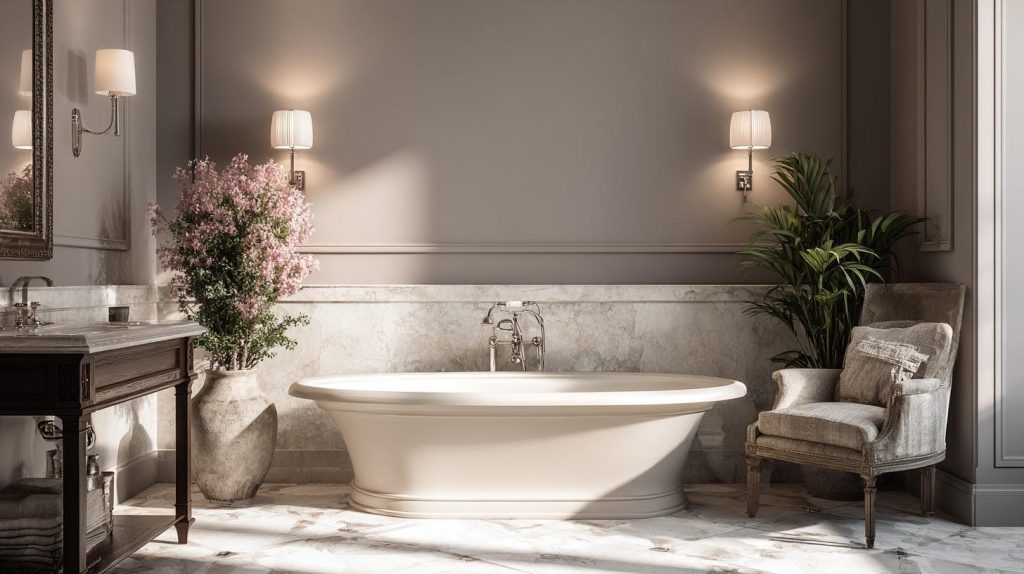
A collected room has rhythm. Materials repeat in a way that feels intentional. Shapes relate to one another. Nothing appears random, yet nothing looks staged to the point of stiffness.
That kind of ease is often missing in bathrooms assembled piece by piece. A mirror is chosen because it is sculptural, a sconce because it is fashionable, a tile because it photographs beautifully, and a faucet because it feels distinctive. None of those decisions are wrong in isolation. The trouble begins when every item is trying to be memorable.
A better approach is to decide where the room’s center of gravity belongs. In some bathrooms, that will be the vanity. In others, it may be a framed view, a stone wall, or even the quiet simplicity of the tub. Once that focal point is clear, the rest of the room can fall into place more easily.
This is also where restraint starts to look like confidence. A bathroom with one strong anchor often feels richer than one with four separate statements competing for the same attention.

Trade-Offs to Consider Before Chasing a Perfectly Minimal Look
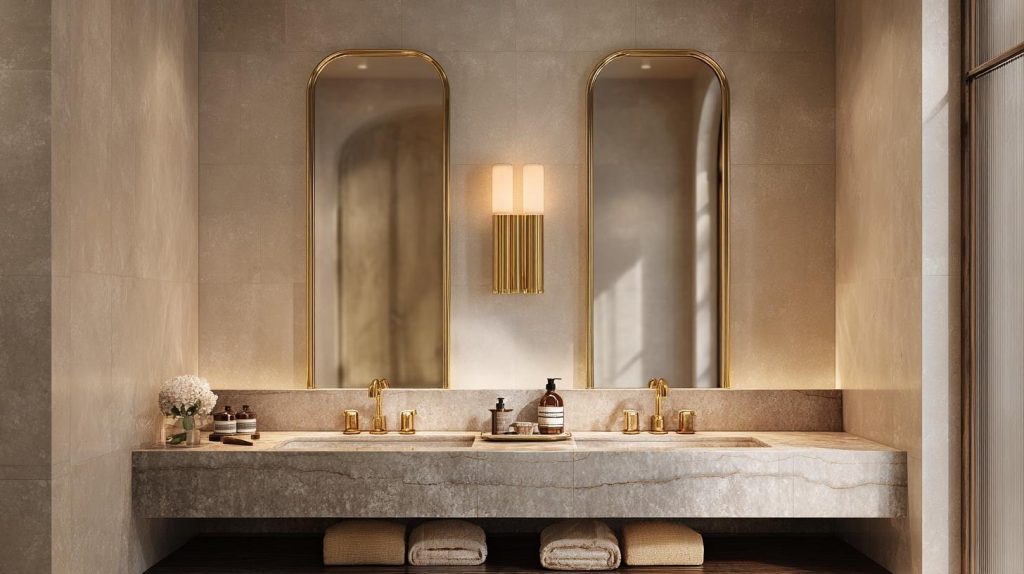
The cleanest solution on paper is not always the one that works best in real life. Bathrooms have practical demands, and calm depends partly on how gracefully those demands are handled.
Open or leggy pieces can lighten the visual weight of a room, but they may leave less concealed storage. Floating forms can make a bath feel larger and more architectural, though they tend to expose whatever is left in view. Pale stone is luminous and elegant, but in a hardworking bathroom it may call for more maintenance than some households want to give.
There is also the reality of routine. Skin care, grooming tools, hand towels, extra toilet paper, cleaning products. These are ordinary things, but if a bathroom has nowhere to absorb them, the room starts to lose its composure quickly.
The best bathrooms make room for use without looking overprepared. That may mean deeper drawers, better internal organization, or a slightly more substantial vanity than the most minimal option first suggests. Practicality does not ruin quiet luxury. In fact, when handled well, it protects it.
Common Mistakes That Keep a Bathroom From Feeling Truly Restful
One common mistake is leaning too heavily on hard, reflective finishes. Stone floor, glossy wall tile, mirrored storage, polished fixtures, bright overhead lighting. The result can feel sharp, even when the palette itself is neutral.
Another is poor temperature matching between materials. A warm wood vanity paired with a cool grey floor often creates subtle tension. The same goes for stone with strong veining set against hardware that is ornate or overly contrasty. None of these choices may seem dramatic on their own, but together they can keep a room from settling.
Lighting is another frequent issue. A bathroom needs task lighting, but not every surface needs to be equally bright. When the entire room is flattened by uniform illumination, it loses depth and softness. Thoughtful bathrooms tend to have layers: useful light at the mirror, gentler ambient light elsewhere, and enough shadow to give the room shape.
Trend-chasing can also work against longevity. An unusual finish or silhouette can be beautiful when it suits the architecture of the room. When several trend-led choices appear at once, the room often dates faster and feels less grounded.
A Simple Framework for Building a Bathroom That Feels Balanced
When a bathroom feels disjointed, a useful place to begin is with mood rather than product. Ask what the room should feel like when you are actually in it. Quiet? Crisp? Cocooning? Airy? That answer should guide the material choices that follow.
From there, choose one grounding material. In many bathrooms, that is wood or stone. Something needs to set the room’s emotional temperature, otherwise the palette can drift into a collection of attractive but unrelated decisions.
Then decide which element deserves the most visual authority. Often it is the vanity, because it occupies a substantial portion of the room and naturally draws attention. Once that has been established, the mirror, lighting, hardware, and surrounding finishes can support rather than compete.
Contrast should be used with care. A little can sharpen a room beautifully. Too much can fracture it. If a bathroom already feels unsettled, reducing the number of strong visual shifts usually helps quickly.
Finally, edit what does not reinforce the room’s mood. That can include accessories, styling, extra finishes, or even an overly assertive wall treatment. A bathroom begins to feel balanced when the eye no longer has to work so hard.
Why the Best Bathrooms Feel Personal, Not Performative
The most convincing bathrooms are not designed for applause. They are shaped around ritual, habit, and the kind of beauty that improves daily life rather than interrupting it.
That is why quiet luxury remains so appealing in this part of the home. It leaves room for wood to warm the atmosphere, for stone to lend substance, and for open space to do what decoration alone cannot. Nothing feels deprived. Nothing feels overexplained. The room simply feels whole.
And that, ultimately, is what makes a bathroom memorable. Not the number of expensive gestures, but the sense that everything belongs.
More to Love!
Transform Your Bathroom Into A Home Spa: Tips And Tricks
Most Instagrammable Bathrooms in the World