SUBSCRIBE


American Hardwood for Luxury Home Interiors
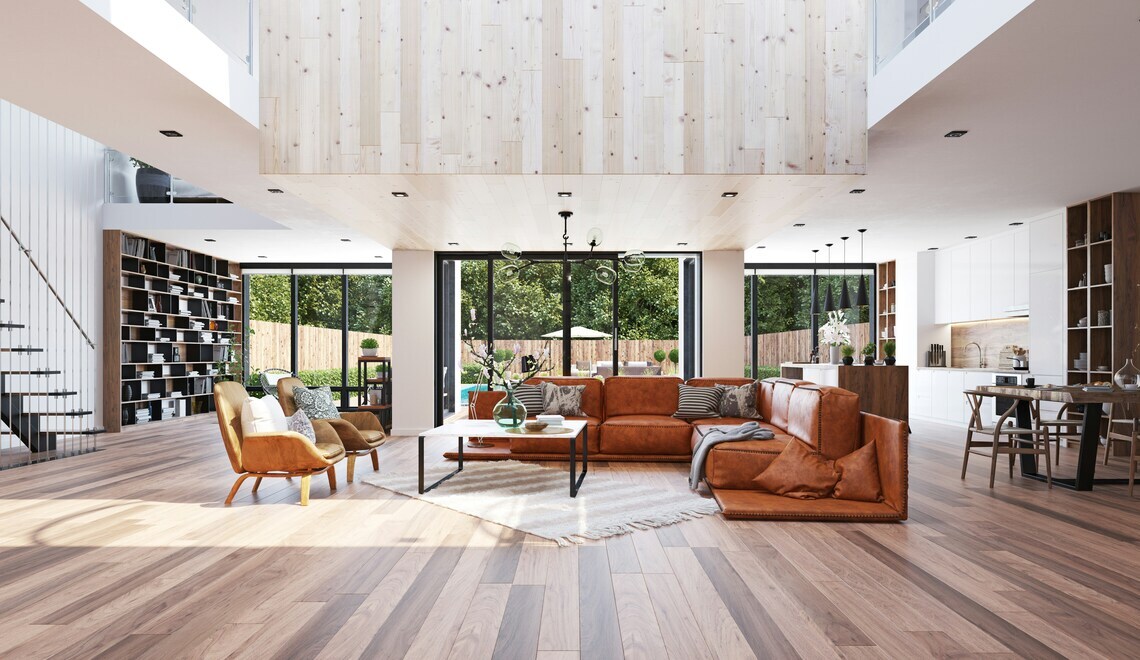
Hardwood is the one interior surface luxury projects still specify in real wood rather than a substitute, and the reasoning is straightforward: the patina that builds over decades, the refinishing capacity that supports successive design refreshes, and the way real wood softens light. The luxury interior-design category has organised over the past 20 years around a recognisable set of American hardwood conventions (wide-plank white oak in the 7-to-10 inch width, natural finishes, character-grade boards over pristine select, sustainable sourcing certifications). Homeowners who understand the conventions before commissioning a designer or speaking with a supplier tend to land at meaningfully better outcomes than those who treat the floor as a finishing decision rather than a foundational one.
Selecting American hardwood for a luxury interior runs differently from the mainstream category. US suppliers like Really Cheap Floors that operate across budget tiers can be a useful reference point for understanding what separates boutique-grade product from the mainstream catalogue before the specialty-mill conversation begins. The cost differential between the right and the wrong product can run into tens of thousands of dollars across a whole-home installation, so a few hours on the front end usually produce a noticeably better result.
Why Does the Luxury Hardwood Category Look Different From the Mainstream?
Luxury and mainstream hardwood are not the same product priced differently. Species mix, board dimensions, grade conventions, finish chemistry, and sourcing traceability all differ.
- Species emphasis. White oak has dominated the upper end for 15 years, displacing red oak. Walnut occupies a smaller formal-traditional and dark-tone modern position. Hickory and maple appear in specialty applications.
- Board width and length. Mainstream runs strip widths (2.25 to 3.25 inches) or short planks. Luxury runs 6-to-10-inch planks at 5-foot average minimum lengths.
- Grade convention. The market shifted from pristine select toward character-grade boards with natural colour variation, knots, and grain figure, which read warmer and less manufactured than the select grade that defined the upper market 30 years ago.
- Finish chemistry. Mainstream still uses polyurethane; luxury has moved toward natural penetrating oils (modified hardwax oils), low-sheen water-based polyurethanes, and factory-applied UV-cured oil finishes.
- Sourcing traceability. Luxury projects specify chain-of-custody certification (FSC, SFI) and documented domestic provenance.
A “boutique” mill is a smaller producer whose output prioritises wide-plank, longer-length boards in character grades. Boutique mills run 6-to-12-week lead times and supply through specialty distributors. Most luxury hardwood projects originate with an interior designer or architect, particularly the firms working at the top of the residential category in markets like New York where the species, width, grade, and finish defaults are clearly established.
What Should Homeowners Look For in a Luxury-Tier Hardwood Supplier?
Eight criteria worth checking before signing on for a luxury-tier installation:
- Wide-plank inventory at real lengths. Boards in 6-to-10-inch widths at 5-foot-plus average lengths. Mostly-short wide-plank stock is mainstream product with a wider profile, not luxury inventory.
- Multiple grade tiers per species. Select, character, and rustic grades within the chosen species, with samples showing each grade’s visual range.
- Finish customisation. Real factory-applied finish options (oil, hardwax oil, water-based polyurethane, custom stain, custom sheen), plus willingness to produce custom samples on real boards.
- Documented sourcing. Chain-of-custody documentation, country of harvest and mill, FSC or SFI certification stamps available on request per product line.
- Honest lead times. Boutique product runs 4-to-12-week lead times. Suppliers quoting immediate delivery on every product are selling mainstream catalogue.
- Sample-programme depth. Large physical samples (12-by-12 inch minimum) on actual species, grade, and finish, with multiple samples showing natural colour and figure range.
- Designer-channel familiarity. Documentation and specification-package conventions the designer side uses. Homeowner-direct intake slows the project workflow.
- Documented warranty. Structural 25-to-50-year, finish warranty matched to chemistry (10-to-25-year polyurethane, shorter for natural oil with maintenance schedule).
What Common Mistakes Do Homeowners Make in the Luxury Hardwood Category?
Recurring mistakes across upper-tier hardwood projects:
- Choosing on photograph alone. The price gap between boutique-mill and high-end mainstream product runs 30 to 60 percent at materials. The visible difference is subtle in photos but obvious in person.
- Underestimating lead time. Boutique-mill product runs 8-to-12-week lead times. Conversations with the supplier should happen well before the construction sequence depends on the floor.
- Specifying by render rather than sample. Hardwood colour, grain, and figure vary too much for any digital surrogate. Luxury projects always work from physical samples at the actual board width.
- Skipping the moisture-and-acclimation conversation. Wide-plank is more sensitive than narrow-plank. Install team should be aligned with the supplier’s acclimation spec before boards arrive.
- Letting the design team specify finish without homeowner involvement. The finish choice affects daily liveability (cleanability, scratch resistance, refinishing options). Homeowner preferences belong in the conversation alongside aesthetic preferences.
- Forgetting maintenance. Natural-oil floors need a documented annual or semi-annual maintenance protocol agreed before install. Without it, the natural oil’s softness reads as poor durability.
- Treating sourcing certification as marketing. AHEC’s American Hardwood Environmental Profile reports document carbon footprint and forest-growth data per species, available on request when supplier claims are unclear.
Homeowners building a visual brief often start with the design and decor magazines that anchor the visual research since published interiors set the conventions that flow through to the supplier conversation.

Frequently Asked Questions About Luxury Hardwood for Home Interiors
How much more does luxury-tier hardwood cost than mainstream?
For a 1,500-to-2,500-square-foot whole-home installation, luxury materials run 50 to 150 percent more than mainstream at retail, with installation labour adding 20 to 40 percent over mainstream rates. Total project budget typically runs 25,000 to 75,000 dollars, against 12,000 to 25,000 dollars for the mainstream equivalent.
Should I work with an interior designer?
Often yes for whole-home installations. Designers familiar with the upper tier can shortcut weeks of research, introduce boutique-mill suppliers who do not market to homeowners, and coordinate the floor with the rest of the interior decisions. Directories like ASID’s accredited-designer listing are one starting point.
Is wide-plank white oak still the right choice in 2026?
For most contemporary and transitional interiors, yes. The category has held steady at wide-plank white oak as the default for over a decade. Walnut occupies a distinct formal-traditional and dark-tone modern niche. Trends inside the white-oak category (rustic grades, natural and pale finishes, longer boards) continue to evolve.
How long does a luxury-tier installation take?
For a 2,000-to-3,000-square-foot whole-home installation, on-site work runs 10 to 20 working days from acclimation through final cure. Boards acclimate 5 to 14 days before install; finish needs 5 to 14 days of light-traffic cure. Supplier order to fully-cured installation runs 12 to 20 weeks.
A Final Note for Homeowners Choosing American Hardwood for a Luxury Interior
The hardwood decision is one of the more consequential interior decisions a homeowner makes in a luxury-tier project, and the project rewards the homeowner who treats the species, the board width and length, the grade, the finish, and the supplier choice with the same care they would apply to any other long-horizon home investment. The homeowners who match the species and grade to the home’s design direction, who specify the wide-plank dimensions that the room scale needs, who request real physical samples on real board widths, who understand the sourcing certification stamps the supplier carries, and who plan the maintenance protocol on the same timeline as the installation tend to come out of the project with a floor that anchors the home for decades. The marginal effort of the careful selection is small. The marginal benefit shows up across the home’s whole life, where the floor is the surface that touches every other room and shapes the way every other interior decision settles into place.
Feature Image by Max Vakhtbovych
More to Love!
The Complete Guide to Refinishing Hardwood Floors
Polished Concrete Floors in Modern Buildings: A Structural and Aesthetic Choice