SUBSCRIBE


3 Self-Awareness Habits That Feel Like a Spa Day for the Soul
They say time and tide wait for no man. In essence, it points to the broader fact that the ebb and flow of life pauses for none. This can generate anxiety, especially since these are times of uncertainty. A 2024 survey found that 77% of the respondents considered the state of America’s political turmoil to be a significant source of stress.
Then, there are often personal struggles to deal with. The rising tide of overwhelm doesn’t just invade the mind; it seeps into the body, reshaping one’s daily experiences. This is precisely why you shouldn’t treat soul care as a luxury.
True nourishment begins when your mind is at ease and healthy. Self-awareness is the key to breaking through the noise of anxiety and the monotony of daily living. This article will share three such habits that will feel like a day at the spa for your soul.
Body Scanning With Compassion
Did you know that the human body is designed to function in the direction of health? This means your body will speak in whispers until the pain demands immediate attention.
Unfortunately, the rush of daily life is such that we learn to numb the signals. Most people are hardwired to normalize and dismiss what should be given serious attention.
One of the most powerful ways to rebuild a solid connection with your body is through a compassionate scan. As you lie down in stillness, it becomes possible to draw your awareness gently through each part of the body.
From your temples to your toes, you will be able to notice subtle tensions and sensations without fear of judgment. Body scanning can particularly help women during their monthly cycle. Most women (84% as per a 2023 Statista study) experience cramps and discomfort during certain points of their cycle, but not many know why.
As Livia explains it, prostaglandins are chemical compounds involved in pain and inflammation. They trigger contractions for the shedding of the uterine lining. Understanding prostaglandins’ role provides clarity to what might otherwise feel random and frustrating.
A simple body scan can help you become attuned to changes in stress levels or posture and their impact on cramps. You may be able to identify your period pain causes, whether emotional, nutritional, or hormonal, based on consistent observations.
With time, you don’t just power through the discomfort, but begin to honor it. It can become an act of self-respect that helps not only with menstruation but also with stress management, gut health, and trauma recovery.

Journaling Without Judgment
Journaling is a practice more common than we think. Firstly, the good news is that it’s not the same as maintaining a diary. The American Diary Project shares the difference. A diary is meant to record daily events, but a journal entry could be intermittent since it’s often more sensitive and interesting.
On days you feel deeply overwhelmed or even ecstatic, a journal can help you get through the clutter of your thoughts. Keep in mind that you don’t have to turn every page into a courtroom. In other words, resist the urge to censor your honesty and polish every sentence.
True journaling for self-awareness isn’t about performance, but presence. You must write as if no one is watching or will watch. Your entries need not make perfect sense, tie neatly, or even come to a resolution. Feel free to calm down your inner critic and let your mind spill out in ink.
From the confusion to the gratitude and everything in between, you can journal it all. The prime focus is not to fix yourself but to witness for yourself. With time, you will observe patterns in the form of what drains you, what excites you, and what triggers you.
You will understand not only what you think but also why you do so. Just like a day at the spa clears the skin and softens the body, journaling without judgment cleanses one’s inner self. It will peel back layers of emotional turmoil, untangle mental knots, and release pent-up thoughts much like a deep tissue massage.
To begin this practice, set a 10-minute timer and write freely. Use gentle prompts to address your body and mind’s deepest needs. End the entry by asking yourself a comprehensive question on what kind of care you need for the day.
Ritualistic, Intentional Daily Rhythms
Do you find yourself simply going through the motions day after day? First things first, technology certainly is to blame for it. Recent research has discovered that offloading cognitive work to AI is damaging brain power.
Younger demographics are particularly displaying shorter attention spans and weaker critical thinking capacity. Living life on autopilot is never a good idea. You may get your work done, ticking off each task on the to-do list, but you don’t get to inhabit your time.
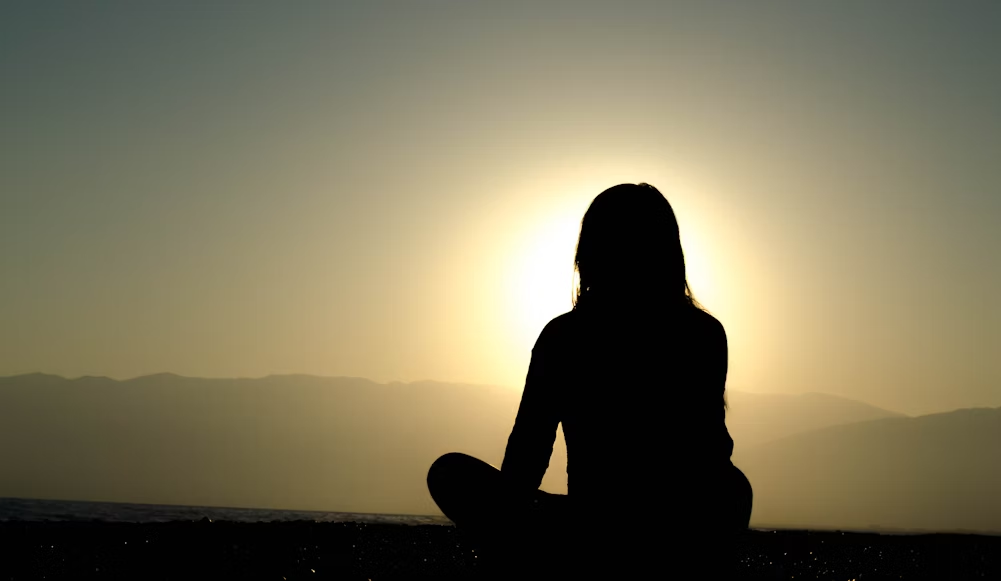
A better way to go about this is to develop intentional rituals. Even if they’re something small, they can become gentle anchors that call you back to yourself. Think of starting each morning with meditation under the soothing flicker of a candle.
If you can’t even take time out for something separate, your ritual can be further simplified into mild music during dinner preparations. Though seemingly insignificant, such actions can become sacred pauses amid the drudgery of daily life.
You will find that those small pockets of intimate moments will turn into avenues for self-awareness. Take the survey of 2024 as an example, which found that 56% of Americans considered ‘alone time’ to be important for mental health. However, nearly half reported not getting enough of it.
Such a longing showcases that even intentional pauses throughout the day can improve well-being. Initially, it may be difficult to maintain an intentional daily rhythm, but once it becomes a habit, your emotional equilibrium will be restored.
Wrapping Up
As we close, here’s a bonus self-care tip: consider creating a soul shelf. It would be a small, sacred corner in your home with objects that soothe and center you. Think about a favorite scent, a beloved book, or a soft scarf.
The coziness will invite you to relax and take a breather daily. True self-care is never an occasional, extravagant affair. It’s an ongoing and deeply personal journey. Instead of hours of silence, you need moments of gentleness and intentionality.
Just spend five to 10 minutes this week on the habits discussed in this article. Consider those moments to be not acts of self-improvement but acts of reverence. You might just be surprised at the results!
More to Love!
How to Create Calming, Sensory-Friendly Spaces at Home
Med Spa vs. Day Spa: What’s the Real Difference?