SUBSCRIBE


A Father, a Son, and a Thousand-Year-Old Art That Is Almost Gone
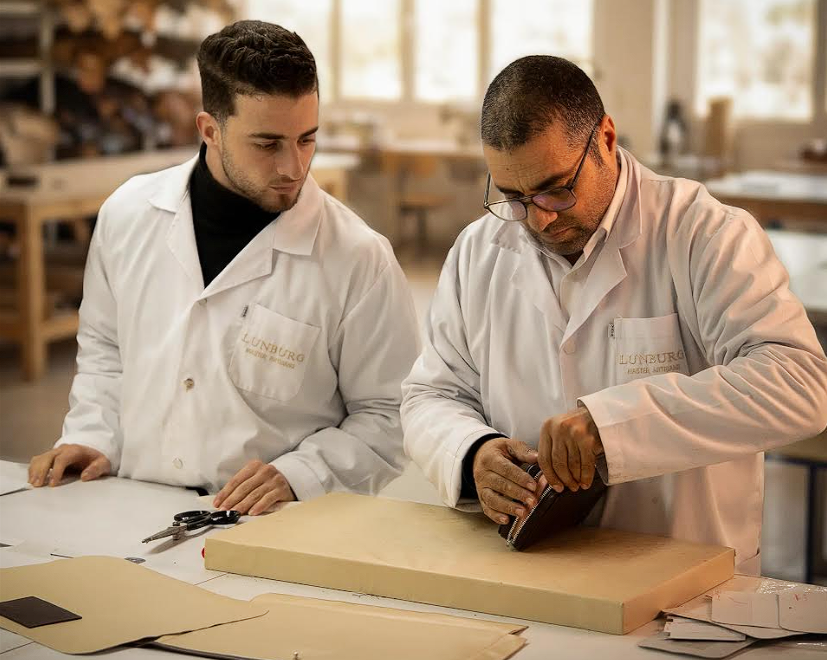
In a workshop in Fes, Morocco, a 52-year-old master leatherworker sits at a bench beside his son, who is 25. Today’s lesson is a fold: how to turn the edge of a piece of leather back over itself so cleanly that the edge shows nothing but unbroken grain. But what the father is passing on is much larger than one movement. It is a complete school of high leathercraft, built in this city across roughly a thousand years and known in French as haute maroquinerie; maroquinerie, the world’s word for fine leatherwork, literally means Moroccan work. The fold, called rempliage, is one technique inside that inheritance, the one by which its masters are measured. The whole tradition is a functional art: objects made to be used, built with the care usually reserved for objects made to be admired. And it is endangered. The pair at that bench may be among the last to hand it on whole, and this article is about why that is, and why it matters to anyone who has ever wanted to own one truly well-made thing.
What the Fold Is, and Why No Machine Can Do It
Of all the techniques in that formation, rempliage is the one that shows its level most clearly, which is why the lesson matters. It sounds simple and is not. The artisan first skives the leather, shaving its border thinner with a blade. Every pass of the blade must stay accurate to one tenth of a millimeter, and the leather is never taken thinner than half a millimeter; too thick and the fold will not close, too thin and the edge has no strength. The thinned border is then turned back over the body of the panel and worked flat, so the finished edge is not a raw cut sealed under paint but leather all the way around, the grain running in one unbroken line from the outer face to the inner. Corners are the hardest test: the extra material has to be gathered into tiny pleats and worked until they vanish into one smooth curve. And nothing can be undone. If a fold fails, that panel is thrown away and cut again, because there is no repair and no way to hide the mistake. The knowledge that keeps all of this from going wrong is not written in any manual; it exists in hands that have performed the movements thousands of times, which is why no machine performs rempliage and mass production has never copied it. The decisions change with every hide, and only long-trained hands can make them fast enough to matter.
A Thousand Years of Royal Commissions
The tradition was built by the most demanding customers a craftsman can have. Fes served as the imperial capital of one Moroccan dynasty after another across twelve centuries, and through that whole span its workshops supplied the courts: bindings for sacred texts, cases made to protect scientific instruments, and folios for the court’s scholars, all of it judged by the standard applied to palaces. Under that pressure the city developed not one clever trick but an entire school of leathercraft, organized in guilds and tied to learning itself: Al-Qarawiyyin, the university that has taught without interruption since 859, treated craft as applied mathematics, and the same geometric training behind the city’s famous tilework taught its leatherworkers to calculate a fold. The school then absorbed a second inheritance: when Granada fell in 1492, Andalusian master leatherworkers crossed to Fes and brought nine centuries of their own refinement into the city’s tradition. The craft ran so deep that families took their names from it; Fes still has surnames that mean tanner, saddler, and stitcher. That whole structure, the royal standard, the guild method, the geometry, and the Andalusian line, is what a Fassi master carries in his hands, and it is what the father at the bench is handing to his son.

Why It Is Endangered
A thousand-year-old school of craft is close to disappearing for four reasons, and none of them is mysterious. The first is a cheap substitute. The luxury industry replaced the folded edge with a painted one: cut the leather, coat the raw edge in a colored film, move on. Painting an edge takes a small fraction of the time that folding one does, and most of the market, including much of most expensive luxury brands, switched; when the buyers of skill switch, demand for the skill collapses. The second reason is where the money goes. The Moroccan artisans who still hold the full formation mostly work unseen, subcontracted through layers of intermediaries, and only a small share of the value their hands create ever reaches them. The third is the arithmetic of a young life. Reaching mastery takes decades, the learning years pay little, and masters’ own children look at that path, compare it with any modern alternative, and choose the alternative. The fourth is the nature of the knowledge itself: because it is carried in hands rather than in books, every master who retires takes his share of the art with him. None of this is unique to Fes. The largest luxury groups admit a version of the same problem; one group’s own training institute has warned that a whole generation of its artisans will retire by 2030, and that learning one such craft properly takes close to ten years. Rempliage simply sits at the far end of the curve: the fewest practitioners, the longest formation, and no industrial technique that produces the same result.
Why It Is Worth Saving, for the Person Who Buys It
The case for this art is not charity; the object itself is the case. Beauty first: an edge with no seam, no paint line, and no transition, just grain curving from one face to the other, on a surface that darkens and gains character for decades instead of wearing out. Complexity second: several layers of leather converging into an edge no thicker than the panel it borders, shaped by hundreds of judgments a machine cannot make. Permanence last, and most practical: because nothing is applied to the edge, nothing on it can crack, peel, or expire, so the piece ages as a whole and can genuinely be used for generations. A mass-produced bag can imitate the shape of such an object. It cannot produce that edge. The difference is visible now and becomes more visible every year the two objects age.
The House Built to Protect It
This is the art Lunburg exists to protect. It is a second-generation house: its founder, Amien Marghich, took the atelier over from his father-in-law, a master who had worked in it since 1968. Marghich’s route there was unusual. He spent more than fifteen years as an engineer working internationally, most recently as a senior engineer at Google, before coming back to the workshop. His reason, as he tells it, is that nothing in world leathercraft matches this art for sophistication and beauty, and that he was watching it be pushed toward extinction by the industrialization and cost-cutting that had already replaced it, almost everywhere, with faster and easier methods. The house’s answer matches the diagnosis. Because the forces killing the craft are economic, the defense is economic too: Lunburg puts forty percent of its profit back into safeguarding the craft, money that funds the long years of formation an apprentice could not otherwise afford, so that mastery stays a trade a young person can reasonably choose. The rest of the answer is the product itself, because a craft survives only if someone demands its highest form. The house’s flagship line, the Opus, is a luxury leather briefcase for men designed entirely around the technique: every edge of every piece folded in the Fes atelier by masters with decades of formation, leather vegetable-tanned over forty days in Tuscany, and a structure covered by a written fifty-year guarantee.
The Question to Ask
There is a simple way to tell whether the word handmade on any label is a fact or a decoration: ask who made the object, and how long that person trained. Makers with real answers publish them. And for this one art, the purchase carries something extra. Every piece bought keeps a master at his bench and gives the next 25-year-old a reason to believe the formation is worth a working life. Very few purchases can honestly claim that. This one can, and you can check it with your finger: run it along the edge. If the grain never breaks, you are holding the thousand-year-old answer.
More to Love!
A Complete Guide to Identify High-Quality Leather
French Elegance & Craftsmanship Embodied In a Leather Bag