SUBSCRIBE


How to Choose Wedding-Day Accessories That Balance Style, Comfort, and Meaning
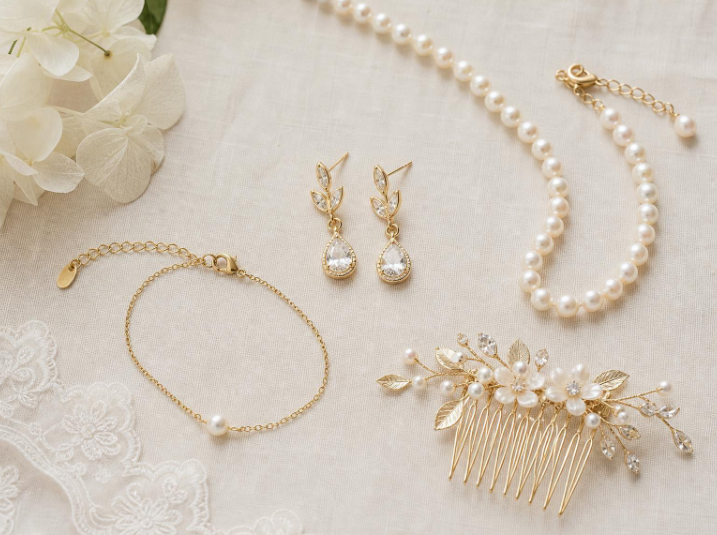
Wedding accessories do far more than complete an outfit. They shape comfort over the course of a long day, influence how photographs turn out, and affect how a dress or suit ultimately reads to the people watching the ceremony. The best choices take into account the outfit’s lines, the venue, the length of the celebration, the hairstyle, and even skin sensitivity. Earrings are a good example: a pair of bridal earrings needs to complement the neckline and hairstyle while staying comfortable enough to wear for eight or more hours without becoming a distraction. The guiding principle throughout this process is simple—choose accessories for harmony, wearability, and personal significance, not just appearance.
Start With the Outfit’s Overall Shape
Consider the neckline. The neckline largely determines how much visual space is available for a necklace or statement piece. Open necklines, like a sweetheart or V-neck, can accommodate a visible pendant or layered chains, while high or heavily detailed necklines usually look more balanced with simpler jewelry. An elaborate neckline paired with a bold necklace can end up competing rather than complementing. The goal isn’t strict matching—it’s coordination that feels intentional.
Account for fabric and embellishment. Lace, beading, sequins, and heavily textured satin all interact differently with jewelry. Delicate lace, in particular, can snag on clasps or textured settings, so it helps to examine the complete outfit—ideally in person—before finalizing any pairing. Thinking in terms of proportion, texture, and visual weight tends to be far more useful here than following rigid style rules.
Coordinate Accessories With the Hairstyle and Face Shape
Match the accessory scale to the hairstyle. Updos, loose waves, short cuts, and veils all change how visible earrings and hairpieces will actually be. A larger earring often looks beautiful with hair swept away from the face, while a more intricate hairstyle may call for something smaller so the two elements don’t visually clash. Testing the actual pairing—accessory and hairstyle together—before the event reveals far more than simply imagining it in isolation.
Use face shape as a flexible guide, not a rule. General style guidance about face shape can be a useful starting point, but it shouldn’t override comfort or personal preference. Trying the same earrings with an updo, with hair down, and with a veil in place often shows that one setting flatters a piece far more than another—something worth discovering ahead of time rather than on the day itself.
Choose Accessories for Comfort and Wearability
Test weight and movement. Wearing potential accessories for a few hours before the wedding is one of the simplest ways to avoid discomfort later. Check whether earrings pull at the earlobe, whether clips pinch, and whether bracelets slide during natural movement like hugging, dancing, or raising a glass.
Check materials and skin sensitivity. Jewelry containing nickel is a well-documented cause of allergic contact dermatitis, with symptoms that can include itching, redness, rash, or dry, irritated skin.[1] These reactions are sometimes delayed rather than immediate, which is exactly why testing jewelry in advance—not just on the wedding day—is genuinely worthwhile.[1][2] “Hypoallergenic” labeling isn’t a guaranteed standard, so checking the specific material composition is more reliable than trusting the term alone. Anyone with a known sensitivity, or a history of unexplained skin irritation, should consider speaking with a dermatologist or requesting a patch test rather than simply guessing.[2]
Key takeaway: An accessory that looks wonderful for ten minutes but becomes uncomfortable after several hours isn’t a successful choice.

Build a Cohesive Accessory Plan
Select a visual focal point. Choosing one primary piece—a necklace, a pair of earrings, or a headpiece—prevents multiple elaborate items from competing with the dress, veil, or bouquet. Supporting pieces can stay simple to maintain that balance.
Coordinate finishes thoughtfully. Gold, silver, platinum, pearls, and colored stones don’t need to match exactly to work well together; the combination just needs to look deliberate. This is also a natural point to consider sentimental jewelry, including family heirlooms, which can be worked into the plan around the focal piece.
Consider the wedding setting. Formality, climate, and ceremony length all affect practical decisions. Outdoor or warm-weather events often call for lighter materials and secure fastenings, and some venues or ceremonies carry specific expectations about jewelry that are worth confirming in advance.
Make Room for Personal and Cultural Meaning
Many couples choose to include heirlooms, birthstones, or culturally significant pieces. When borrowed or valuable items are involved, confirming ownership, insurance, and safe handling ahead of time avoids unnecessary stress later. Assigning one trusted person to store jewelry after the ceremony is a simple but practical safeguard. Because traditions vary so widely, consulting a knowledgeable family member or ceremonial authority tends to be far more reliable than general online guidance.
Prepare, Maintain, and Store Accessories Properly
A short pre-event checklist can prevent last-minute problems:
- Inspect clasps, posts, backs, and settings for looseness.
- Pack spare fasteners or earring backs.
- Photograph the complete accessory combination beforehand.
- Store pieces in labeled compartments to avoid tangling.
Cleaning should match the material. Pearls, for example, should never be soaked or exposed to harsh chemicals, since moisture and chemical exposure can damage their surface or weaken the stringing.[6] When in doubt, a soft, dry cloth is the safest option, and valuable or antique pieces are best left to professional cleaning.
Use Photography and Practical Testing to Make the Final Decision
Reflective metals, fine detail, and low-contrast pieces can all photograph quite differently than they appear in person. Testing accessories in natural daylight and under lighting similar to the venue, then reviewing front, side, and movement shots, helps catch surprises early. A full rehearsal with the complete outfit, hairstyle, and shoes remains the most reliable way to confirm that everything actually works together.
A Balanced Final Look
The decision sequence is straightforward: start with the outfit, consider hairstyle and scale, test comfort and materials, account for setting and meaning, then prepare each piece in advance. There is no single correct combination—only the one that allows the wearer to feel comfortable, confident, and fully present throughout the day.
More to Love!
Luxury Wedding Stylebook: What’s in Vogue this Wedding Season
Add Bling to Your Big Day with This Seasonal Guide to Wedding Jewelry