SUBSCRIBE


Timeless Kitchen Design: How to Build a Kitchen That Won’t Date
Every few years, the kitchen gets a new uniform. Not long ago it was all-white everything — white cabinets, white counters, white subway tile marching up every wall. Then came the black-and-brass moment, the green cabinet moment, the reeded-wood-and-arched-doorway moment we’re still very much living in. Each one felt fresh the day it arrived and, if you look closely, each one has already started to feel like a photograph with a timestamp on it, the opposite of timeless kitchen design.
Which raises the real question for anyone actually renovating: how do you build something you’ll still love in five years, without ending up in a kitchen that looks like it never left a particular season of Pinterest?
The Difference Between a Trend and a Taste
Trends move fast because they’re easy to copy. A cabinet color, a hardware finish, a tile pattern: these are things you can screenshot and replicate almost exactly, which is precisely why they saturate so quickly and age the same way. What doesn’t age nearly as fast is taste: the underlying instinct for proportion, material honesty, and how light moves through a room. A kitchen built on taste rather than trend borrows ideas from the moment without copying its surface details wholesale.
The clearest sign a kitchen has been designed this way is that you can’t quite date it. Walk into a beautifully proportioned kitchen with well-chosen natural materials, and it rarely announces a decade. Walk into one dominated by whatever finish was trending when it was built, and it usually does.
What Tends to Age Well
A few elements have proven, across multiple design cycles, that they hold up:
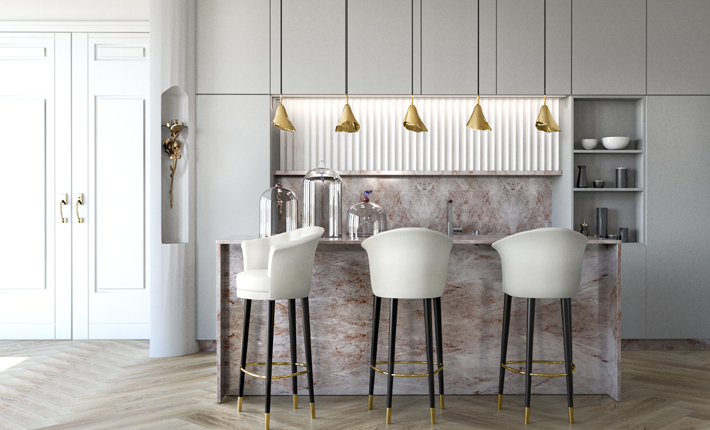
- Natural stone and wood, because they carry their own texture and variation rather than relying on a color that can go out of fashion.
- Simple, well-proportioned cabinetry, where the craftsmanship and detailing do the work instead of an eye-catching finish.
- Layered lighting (task, ambient, and accent working together), which flatters a space regardless of what year it is.
- A restrained material palette, generally two or three primary materials used with intention, rather than five competing statement choices.
None of these are boring. They’re simply built around qualities that don’t have an expiration date attached.
What Tends to Date Quickly
The flip side is usually anything tied tightly to a single, very specific moment: an extremely saturated cabinet color, a highly graphic tile pattern used everywhere at once, or hardware so distinctive it reads as a signature of “right now” rather than a quiet detail. None of this is inherently wrong to love. The issue is scale: the more surface area a trend covers, the faster the whole room feels tied to its era once the trend moves on.

Where Trend Actually Belongs
None of this means playing it safe with beige forever. The smartest kitchens borrow the energy of a trend in places that are easy and inexpensive to change later: a bold pendant light over the island, an accent stool, an art piece, seasonal styling on open shelves. This is where you get to have fun with a current moment without betting the whole renovation on it. If the trend fades, you swap a light fixture. You don’t gut a kitchen.
Why the Team You Build With Matters as Much as the Choices You Make
Here’s the part that gets overlooked: even a homeowner with genuinely great instincts can end up with a dated kitchen if the execution doesn’t hold up. A well-executed kitchen Design starts with people who understand not just what looks good today, but which materials, proportions, and layouts have actually stood the test of time across many completed projects. That perspective is hard to get from inspiration boards alone; it comes from having seen which choices homeowners are still thrilled with a decade later, and which ones quietly got renovated out.
This is also where craftsmanship earns its keep. A timeless material poorly installed still looks dated fast, while even a slightly trendy choice, executed with real precision, tends to age more gracefully than expected. The difference between a kitchen that feels intentional in ten years and one that feels stuck in 2026 often comes down to the quality of that execution as much as the design decisions themselves.
The Bottom Line
Building a kitchen that won’t date isn’t about avoiding trends altogether; it’s about knowing where they belong. Let the bones of the room (materials, proportion, light) be the part that’s built to last, and let the smaller, swappable details carry whatever feels exciting right now. Do that, and the kitchen won’t just survive the next five years of design cycles. It’ll feel like it was never chasing them in the first place.
More to Love!
Luxury Kitchen Design Decoded: An Expert’s Golden Tips
The Heart of the Home: Decorating and Designing Kitchen Islands
Balancing Style and Function in Your Kitchen Renovation
10 Ways to Spruce Up an Outdated Kitchen