SUBSCRIBE


The Modern Parent’s Luxury: Why a Premium Bottle Washer Belongs in Every Thoughtful Home

There is a version of parenting that looks effortless from the outside. The kitchen is tidy, the baby is calm, and the parent actually got a full cup of coffee while it was still warm. That version exists. It just requires the right setup.
One thing separating that version from the chaos version is how you handle the repetitive daily tasks. Bottle care is one of the biggest ones, and most parents are still doing it the hard way without realizing there is a better option.
The Bottle-Feeding Reality: Why Cleanliness Matters More Than You Think
Bottle feeding is not just about nutrition. It is about safety. Every bottle your baby uses needs to be genuinely clean, not just rinsed, not just quickly scrubbed. Truly clean.
Beyond Hand-Washing: Understanding Hygiene Standards for Feeding Equipment
The American Academy of Pediatrics recommends sterilizing bottles before first use and washing them thoroughly after every single feed. For newborns especially, whose immune systems are still developing, this is not optional.
The problem with hand washing is consistency. You do it well when you are alert and unhurried. At 3 a.m. after the fourth night feed, your standards drop a little. That is just being human. But the bacteria in leftover milk residue does not care what time it is.
Milk proteins and fats cling to plastic surfaces in ways that plain rinsing does not remove. Over time, residue builds up in the threads of bottle caps, under nipple flanges, and at the bottom curves of bottles. These are the spots that cause problems.
The Hidden Labor of Manual Bottle Care
Here is the math most parents do not think about until they are already in it:
- Newborns feed 8 to 12 times per day
- Each bottle needs washing, rinsing, and drying
- That is easily 45 to 60 minutes of bottle-related tasks per day
- Over the first year, that adds up to roughly 270 hours
270 hours. That is more than 11 full days spent on bottle washing. When you look at it that way, investing in something that handles this more efficiently stops being a luxury and starts being obvious.
The Evolution of Bottle Care: From Basic Racks to Smart Solutions
Bottle care has come a long way. The first generation of solutions was just a drying rack and a bottle brush. Then came dishwasher baskets. Then sterilizers. Now there are machines that wash, sterilize, and dry in one cycle without you doing much of anything.
What Modern Bottle Washers Actually Do
A modern baby feeding bottle washer does not just spray water at a bottle. It uses directed water jets that reach into every part of the bottle, including the areas a brush consistently misses. Then it sterilizes using steam or UV light. Then it dries everything so there is no trapped moisture where mold could grow.
The result is a bottle that is cleaner than what most hand washing produces, done faster, with far less effort from you.
Some models also handle other feeding accessories: breast pump parts, pacifiers, sippy cups. So as your baby grows, the machine keeps being useful instead of sitting unused.
Why Design-Conscious Parents Are Switching
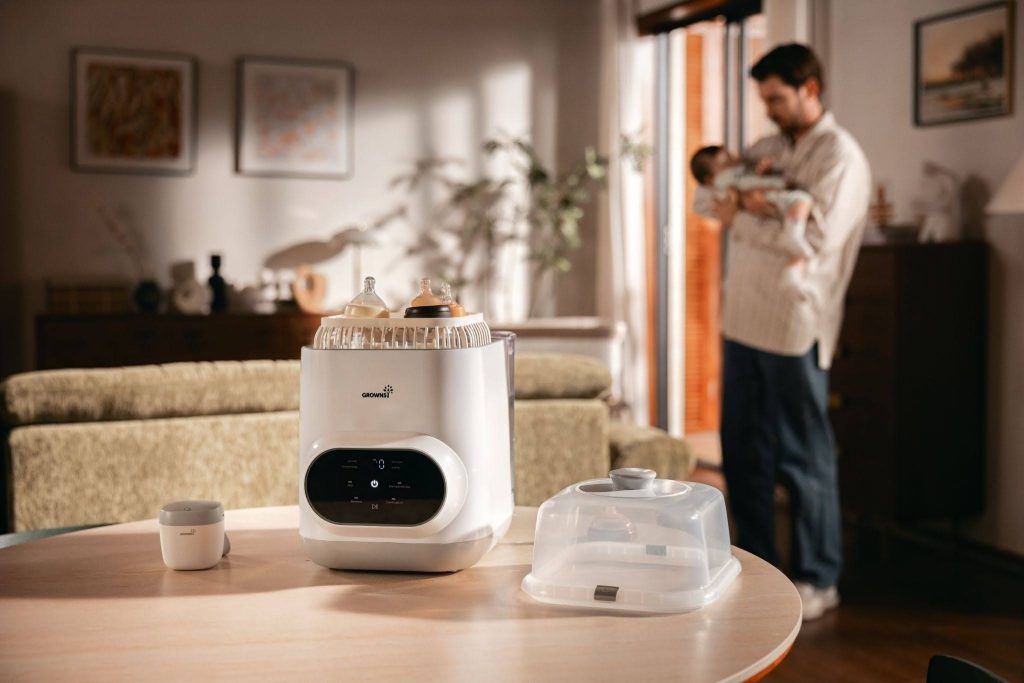
Beyond the hygiene benefits, there is a design argument too. A quality bottle washer sits on your counter and actually looks like it belongs there. It does not look like baby gear that invaded your kitchen. The better models have clean lines, muted finishes, and a compact footprint that fits alongside your other appliances without clashing.
For parents who care about how their home looks and functions, this matters. Baby products that work well and look good are genuinely harder to find than they should be.
Choosing the Right Bottle Washer: A Buyer’s Guide for the Discerning Parent
Not every bottle washer is built the same. Here is what actually separates a good one from one that will frustrate you within a week.
What to Look For in a Premium Model
Cleaning Method: Look for rotating spray jets that cover the full interior of bottles, not just a single fixed nozzle. The inside bottom of the bottle and the nipple area need direct attention.
Sterilization: Steam sterilization is effective and does not require any chemicals. UV sterilization is also good. Avoid anything that relies only on hot water without a dedicated sterilization step.
Drying: This is where many machines fall short. Drying matters as much as cleaning. Wet bottles left assembled will grow mold. A machine with a built-in drying function, preferably with HEPA-filtered air, handles this properly.
Capacity: Consider how many bottles you go through per day. A machine that holds four bottles when you use eight means you are running two cycles every time.
Noise Level: You will be running this during naps and at night. Quieter is better. Check reviews specifically for this.

The 3-in-1 Advantage: Why Combined Solutions Make Sense
A baby bottle washer sterilizer and dryer that handles all three steps in one unit has a clear advantage over buying separate machines for each function.
First, counter space. Three separate appliances take up three times the space. One machine handles everything.
Second, workflow. When washing, sterilizing, and drying happen in sequence inside one machine, you put bottles in dirty and take them out ready to use. There is no transferring wet bottles to a separate sterilizer, then moving them again to dry. The fewer manual steps, the fewer opportunities for contamination.
Third, cost. A good 3-in-1 unit typically costs less than buying quality versions of each function separately.
Material Quality and Durability
Look for food-grade materials throughout, both in the machine’s interior and in any baskets or racks that contact the bottles. BPA-free is standard now, but also check that the plastic used is rated for repeated high-temperature exposure.
Stainless steel interiors hold up better over time than plastic ones and do not absorb odors. If you plan to use the machine for more than one child, or for an extended period, the interior material is worth paying attention to.
Integrating Baby Gear Into Your Home Aesthetic
One of the quiet frustrations of early parenthood is what it does to a home that used to feel considered and put together. Suddenly there is gear everywhere, in colors that do not match anything, taking up space that used to hold something you actually chose.
Making Space for Parenting Essentials Without Compromising Design
The answer is not to hide everything. It is to choose better. When you select baby products that are thoughtfully designed, they do not need to be hidden. They fit in.
A few things help:
- Choose neutral colors. White, grey, and soft beige work in almost any kitchen. Bright primary colors do not.
- Prioritize compact design. A machine with a small footprint is easier to integrate than one that takes over a whole section of counter.
- Limit what stays on the counter. Only keep what you use every day. Everything else goes in a cabinet.
The bottle washer earns its permanent counter spot because it gets used multiple times daily. It is not clutter. It is infrastructure.
The Wellness and Design Connection
There is a real connection between a functional, well-organized space and how you feel in it. Parents who are already running on limited sleep and high stress do not need an environment that adds visual noise on top of that.
A clean, organized feeding station, one where everything has a place, and the bottle washer handles the heavy lifting, reduces daily friction in a way that is hard to quantify but very easy to feel.
The Broader Picture: Parenting as a Lifestyle Practice
The most thoughtful parents are not the ones who do everything manually to prove a point. They are the ones who figure out where to spend their energy and where to let a good tool do the work.

Time as Luxury
Time is the one thing you cannot get more of. Every hour not spent scrubbing bottles is an hour for something else, sleep, connection with your partner, time with your baby that is not task-focused. That trade-off is worth taking seriously.
Thoughtful, Long-Term Parenting Choices
Choosing quality over quantity also applies to baby gear. One well-made bottle washer that lasts years is a better choice than cycling through cheaper options that wear out or stop cleaning effectively. It is also less waste, which matters if you think about what your buying habits say about your values.
FAQ: What Every Parent Should Know Before Investing
How long do premium bottle washers typically last? A well-built machine should last three to five years with regular use. Some go longer. Read reviews specifically looking for long-term ownership feedback, not just first impressions.
Are they truly more hygienic than hand-washing? For most people, yes. Not because hand washing cannot be done well, but because machine washing is consistent in a way that human effort at 3 a.m. is not. The cleaning jets reach areas a brush misses, and the sterilization cycle does what boiling water on the stove does without requiring you to stand there.
Can they handle all bottle types and brands? Most quality machines are designed to work with standard bottle sizes and shapes. If you use wide-neck bottles or a less common brand, double-check compatibility before buying. The product page or manufacturer support can confirm this.
Is it worth the investment for a short window of bottle feeding? This depends on how long you plan to bottle feed and whether you will have more children. If you bottle feed for twelve months and have two children, you are looking at two years of daily use. At that scale, a quality machine pays for itself in time saved many times over. And many of these machines work for breast pump parts, sippy cups, and other items beyond infancy, extending the useful life further.
The Luxury of Ease
The best parenting tools are the ones you stop noticing because they just work. The bottle washer becomes part of the routine, the counter, the rhythm of the day. You put bottles in, you take clean bottles out, and your attention goes elsewhere.
That is not laziness. That is good design working the way it is supposed to.
More to Love!
What Happens If I Don’t Warm My Baby’s Bottle? Safety, Feeding Comfort, and What to Expect
Breastfeeding and Coffee: What Every New Mother Should Know