SUBSCRIBE


The Quiet Luxury of Watercolor Painting
Luxury has been quietly changing shape. The most coveted possession in the room is no longer an object at all. It is an hour of uninterrupted time, and the women we find most inspiring are increasingly spending that hour with a paintbrush in hand.
Creative rituals have become the new wellness. Ceramics studios have waiting lists, ateliers offer sketching evenings with champagne, and five star spas from Provence to Palm Beach now schedule painting hours alongside massages, often booked out weeks ahead. Among these, watercolor has emerged as the medium of the moment, and it is not difficult to see why. It is portable, forgiving, and inherently beautiful, even in inexperienced hands. Especially, perhaps, in inexperienced hands.
Why Watercolor, Why Now
We live surrounded by screens that demand reaction. Watercolor demands the opposite: attention. The medium moves at its own pace, pigment drifting through water in ways that cannot be rushed or entirely controlled, and the painter has no choice but to slow down and watch. In an economy where everyone is reachable at all times, the ability to be genuinely unreachable for an hour has become the rarest indulgence there is.
There is also the medium’s particular elegance. Watercolor is translucent, luminous, and a little unpredictable, closer in spirit to silk than to plastic. A loose wash of pigment on cotton paper has the same quality as a handwritten letter or a well-made martini: it simply cannot be automated into meaning less. That analog character is precisely what makes it feel so current. The pedigree does not hurt either. Turner carried watercolors across Europe, Sargent painted them between society portraits, and Georgia O’Keeffe filled early sketchbooks with washes of color. To paint in watercolor is to join a rather glamorous lineage, even on the days the tulip goes sideways.
The Ritual
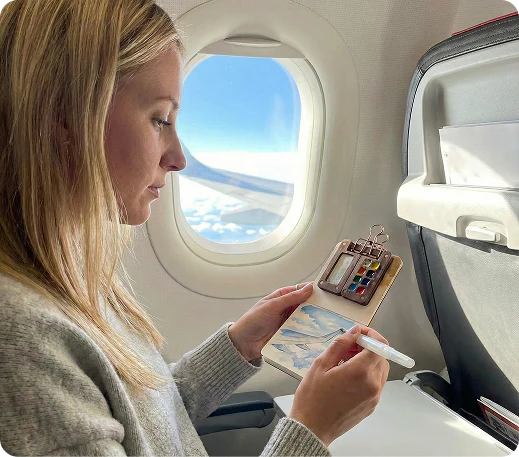
The women who paint describe it less as a hobby and more as an appointment with themselves. Morning light at the kitchen table before the day begins. Twenty minutes on the terrace with a glass of something cold, painting the view rather than photographing it. The subject barely matters. The flowers on the table, the fruit in the bowl, the particular blue of the evening sky just before the lamps come on. What matters is the pause. The ritual travels beautifully, too. A small tin slips into a weekend bag more easily than most skincare, and fifteen minutes painting the harbor from a hotel balcony will fix a place in memory more permanently than two hundred photographs. Frequent travelers we know now pack paints the way they once packed novels.
The mind and body case is quietly compelling. Painting occupies the hands and softens the mental chatter in a way that meditation promises and rarely delivers for the restless among us. There is a reason art has been prescribed for stress for over a century. It works, and unlike most things that work, it leaves you with something lovely to show for it. Those who keep the ritual describe the same arc: the first pages are stiff and self conscious, and then one morning, somewhere around the third week, the inner critic quiets and the hour begins to feel less like practice and more like the best appointment of the day.

Beginning Beautifully
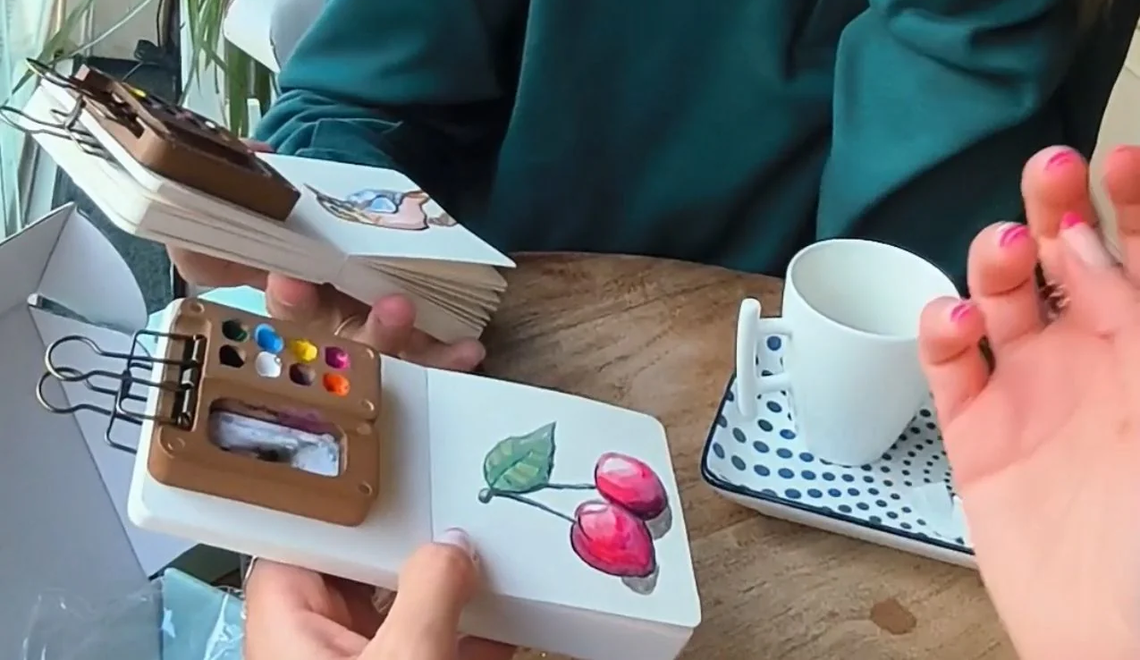
Part of the pleasure, as with any ritual worth keeping, is in the tools. A well-made kit, thick cotton paper, a brush that comes to a fine point, all of it arranged on a tray. There is no need for a studio or an easel. The corner of a beautiful table is the studio, which is rather the point. And unlike most hobbies, the equipment earns its place on display. A handsome tin and a jar of brushes live happily on a coffee table or writing desk, less clutter than invitation.
For those starting out, a curated set removes every excuse. The Tobios watercolor collection was designed for exactly this kind of beginner, everything needed in one refined tin, with guided tutorials and workbooks that assume no experience at all. Begin small: a single flower, a wash of one perfect color, the view from wherever you happen to be sitting.
One gentle warning: resist the urge to compare your first pages to the painters of Instagram. The entire value of this ritual lives in the doing, and a slightly crooked tulip painted in blissful silence is worth more than any flawless image scrolled past in a waiting room.
Art in the Interior
Here is where the ritual repays the design lover twice over. The most compelling interiors we feature share one quality: they are personal, layered with objects that carry meaning rather than merely price tags. Nothing is more personal than art made by the hand of the person who lives there. A series of small watercolor studies, floated in generous mats and hung as a trio, brings a wall the kind of intimacy no print edition of five thousand ever could.
Designers have long used watercolor studies this way, in powder rooms, along staircases, propped on picture ledges where they can be rotated with the seasons. A summer of small paintings becomes next year’s gallery wall. The work matures with the collection, and unlike almost everything else in the home, it appreciates in sentiment rather than depreciating in fashion. For those who commission art, painting changes that relationship too. An eye trained by even casual practice chooses better, negotiates the mat and frame with confidence, and knows precisely why a piece works where it hangs.
Quiet luxury was never really about logo-less handbags. It is about presence, taste exercised in private, and the confidence to value one’s own time. A small painting habit delivers all three. One tin of paint, one beautiful hour, and a page that exists nowhere else in the world. This season, while everyone else is queueing for the next it bag, consider claiming the quieter prize instead. We can think of no lovelier object of desire.
More to Love!
Innovative Art JaeSuk Kim, The Artist Behind the Susu Girls
How to Love Yourself: The Good Morning Goddess Ritual of Self-Love