SUBSCRIBE


How to Match Patio Paving to Your Home’s Facade?
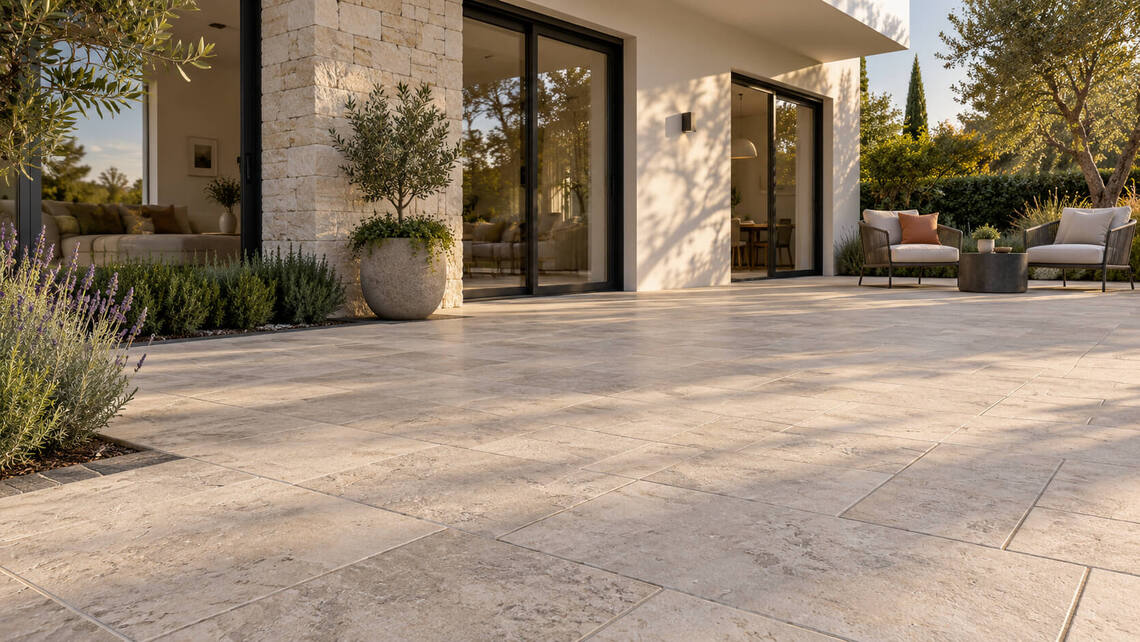
Match patio paving to your home’s facade by repeating an undertone from its permanent materials, choosing a complementary lightness, and coordinating texture and pattern with the architecture. Then check exposure: the U.S. Environmental Protection Agency explains that paving which reflects more solar energy can remain cooler than conventional surfaces. Color selection therefore affects performance as well as appearance.
Solidshape outlines the key color, material, and style considerations for coordinating patio pavers with your home’s exterior.
What Is Facade-Coordinated Patio Paving—and Why Choose It?
Facade coordination means selecting paving in relation to the exterior walls, roof, windows, and other permanent finishes. It involves three separate decisions: hue, lightness, and texture. A gray paver, for example, may lean blue or beige; the color name alone cannot establish compatibility.
Pavers are individual units within a larger pavement assembly. Their setting bed, base, joints, and drainage affect performance alongside the visible material. The Concrete Masonry & Hardscapes Association (CMHA) treats these components as an integrated system in its guide, Construction of Interlocking Concrete Pavements.
The appeal is straightforward: the patio can feel like an extension of the house while serving a different exposure. Identical appearance does not mean identical specification. The Tile Council of North America (TCNA) defines porcelain as tile with water absorption of 0.5% or less, tested under ASTM C373, but that definition alone does not establish suitability for every outdoor application.
Benefits of Coordinating Appearance and Performance
- A clearer visual hierarchy. Repeat one facade color and use a restrained border to organize the ground surface. The Brick Industry Association (BIA), in Paving Systems Using Clay Pavers, explains how colors, bands, and borders change the perceived scale of a paved area.
- More comfortable sunny spaces. Consider pale or medium tones, then request reflectance information. EPA identifies solar reflectance as a cooling mechanism; its findings do not establish a universal temperature advantage for limestone, travertine, or porcelain. Shade remains part of the design.
- Repairable detailing. Where suitable, consider a sand-set pavement that allows access below individual units. BIA identifies easier underground utility access as an advantage of this clay-paving system compared with bonded alternatives.
Applications: Where the Approach Works—and Where to Reconsider
Use a shared palette across a patio, courtyard, entrance path, and pool surround, but specify each zone separately. A dining terrace needs stain management; a pool edge needs a finish assessed for wet barefoot use.
Wet areas: Do not select a polished surface solely because it matches indoor flooring. TCNA distinguishes an Exterior, Wet (EW) classification from an interior wet DCOF criterion of 0.42. DCOF measures sliding friction under test conditions; it cannot independently predict whether someone will slip. Drainage, contaminants, and maintenance also matter.
Freezing climates: Avoid stone without evidence supporting the intended exposure. The Natural Stone Institute (NSI) explains that moisture entering susceptible stone can contribute to deterioration during freezing. A stone’s commercial name does not establish frost resistance.
Raised terraces and heavy loads: Have a professional confirm structural capacity, waterproofing, supports, and the intended loading. An attractive patio unit should not automatically be extended into a driveway or pedestal installation. CMHA’s guidance distinguishes pedestrian and vehicular pavement requirements.

Design Styles: Pair the Paving with the Architecture
Treat these combinations as starting points for a physical sample review.
Traditional Red-Brick Homes
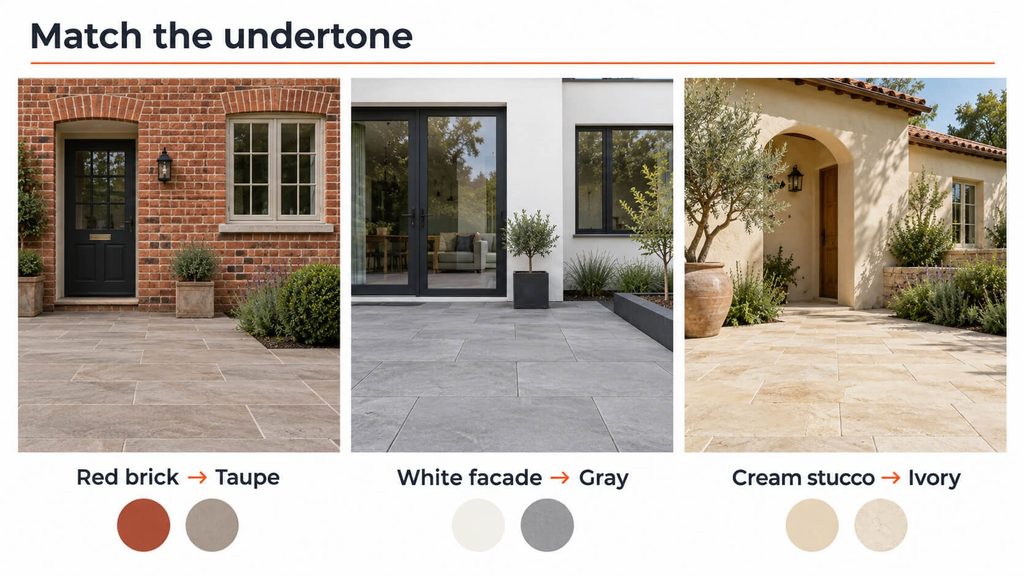
Start with the mortar. A muted gray or taupe paver can pick up that quieter color without adding another strong red. Where terracotta is preferred, choose a deliberately distinguishable tone and preview the full pattern.
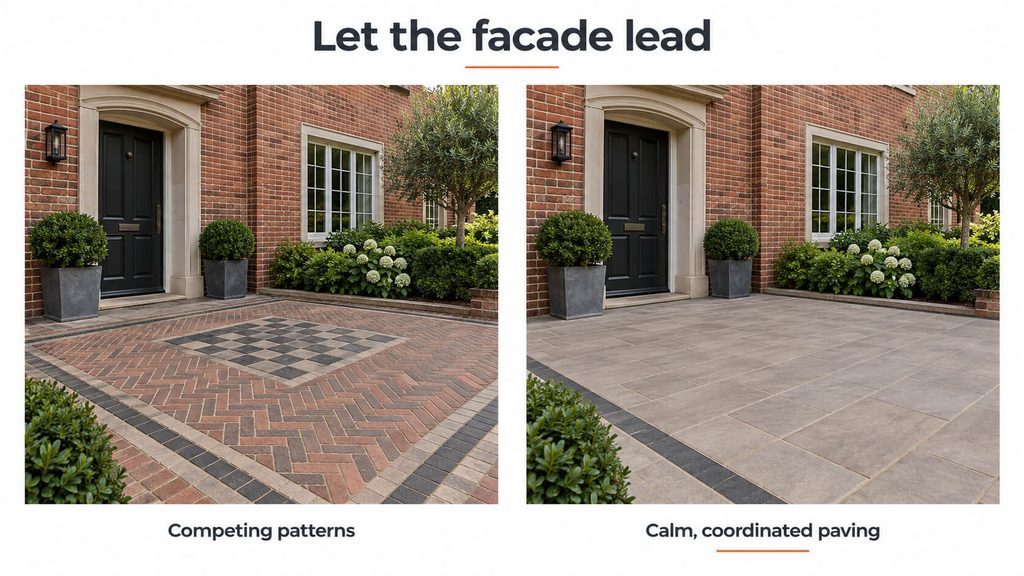
Try a simple rectangular field beside heavily textured brick. Reserve herringbone or basketweave for a courtyard where the paving can carry more detail.
Modern White or Gray Exteriors
For a white house with charcoal frames, consider medium-gray porcelain or textured granite. A narrow darker border can repeat the window color without making the entire terrace dark.
For gray siding, compare the actual undertone before choosing gray paving. A blue-gray wall and beige-gray floor may need a shared trim or joint color to connect them. Larger rectangles and aligned joints are useful starting points for clean architectural lines.
Mediterranean Stucco and Clay-Tile Roofs
Warm limestone, ivory travertine, or stone-effect porcelain can support cream stucco and terracotta roofs. Compare an orderly rectangular layout with a modular pattern before committing: an already detailed facade often benefits from quieter paving.
Where natural stone is selected, approve its variation and finish alongside the coping and steps.
Craftsman, Timber, and Mixed-Material Facades
Consider buff, brown-gray, or subdued multitone paving alongside timber and earthy masonry. If the house combines brick, stone, and siding, identify the dominant permanent surface and use the others as accents.
Avoid choosing a different paving color for every exterior material. A shared neutral can provide continuity without copying each finish.
Practical Selection Checklist
- Build a horizontal sample panel. Include several paving units, the proposed joint material, and a coping sample. Review it beside the facade when dry and wet, in sun and shade. Belgard recommends actual samples because displayed colors can differ from the product.
- Review the important views. Check the combination from the main doorway, indoor seating area, and garden approach. Approve the overall relationship before studying individual pieces.
- Request product evidence. Obtain absorption, strength, abrasion, wet-use, and relevant freeze-thaw results for the exact product and finish. Avoid treating one rating as a complete durability assessment.
- Confirm dimensions and support. Archatrak offers porcelain pavers in 20, 30, and 50 mm thickness categories; these are product choices, not interchangeable installation specifications. BIA lists common clay-paver face sizes of 4 × 8 inches and 3⅝ × 7⅝ inches.
- Resolve water management. Ask the installer to detail drainage away from the building, threshold clearances, and movement accommodation. CMHA’s construction guidance addresses grading, drainage, and preparation of the supporting layers.
- Compare complete quotations. Include removal, ground preparation, drainage, delivery, cutting, edging, installation, and any recommended sealing. Approve maintenance expectations and replacement availability before ordering.
Material Comparison: Limestone and Five Alternatives
The following U.S. material-only estimates, in USD per square foot, come from HomeGuide’s Pavers Cost Per Square Foot, Limestone Pavers Cost, and Travertine Pavers Cost guides, consulted in September 2026. Their publication dates vary; use them as budgeting references, then obtain current local quotations. They exclude installation and project-specific extras.
| Material/Option | Appearance | Durability with data | Maintenance | Cost range | Best use case |
| Limestone | Subtle cream, buff, or gray | NSI identifies calcium carbonate as acid-sensitive. Request quarry-specific test results. | Non-acidic cleaning; sealing as specified | $7–$15 | Quiet natural texture beside stucco or stone |
| Travertine | Warm variation and characteristic voids | Assess the supplied stone and filling; no universal frost rating follows from its name. | Clean recesses; assess sealing needs | $5–$30 | Mediterranean courtyards where natural variation is desired |
| Exterior porcelain | Consistent stone or concrete effects | TCNA: porcelain absorption ≤0.5%; confirm outdoor classification. | Routine cleaning; Archatrak generally specifies no sealing. | $5–$10 | Consistent color with limited surface upkeep |
| Concrete pavers | Broad neutral and blended palettes | ASTM C936: average strength ≥8,000 psi; average absorption ≤5%, per CMHA. | Maintain joints; manage stains | $3–$6 | Flexible palettes and a restrained material budget |
| Clay brick | Earthy tones and smaller modules | BIA: ASTM C902 SX addresses freezing while saturated; Type I abrasion index ≤0.11. | Clean and maintain joints | $2–$6 | Traditional patterns and fired-clay character |
| Granite | Crystalline gray, buff, or darker tones | NSI notes abrasion resistance; obtain quarry-specific strength and absorption data. | Routine stone care | $10–$15 | Heavily used paths where natural stone is preferred |
These test criteria are not interchangeable measures of lifespan or installed load capacity. Porcelain can be the better choice for a consistent finish; concrete for budget flexibility; clay for traditional patterns; and granite for demanding natural-stone applications. Limestone and travertine suit projects prioritizing their particular texture and variation, provided exposure is appropriate.
Maintenance and Longevity
Sweep debris, address spills promptly, and use a cleaner compatible with the material. In Care & Cleaning of Natural Stone, NSI recommends mild, non-acidic cleaning for calcium-carbonate stones; vinegar can etch limestone and travertine.
Sealing requires a product-specific decision. NSI explains that impregnators improve stain resistance rather than making stone stain-proof, and some stones do not require sealing. Follow the supplier’s recommendation for the treatment and renewal interval instead of assuming every patio needs annual resealing.
As a practical maintenance schedule, inspect drainage, loose units, and joint loss each spring and after severe weather. Have developing movement assessed before it spreads.
For expected service life, NSI states that correctly selected and installed natural stone can perform for generations. This is conditional potential, not a warranty for a particular patio. Request an assembly-specific service-life expectation and written warranty; individual material ratings cannot supply either.
Common Mistakes to Avoid
- Choosing from a screen without checking physical samples against the facade.
- Matching the wall color while ignoring mortar, trim, joints, and coping.
- Combining a busy facade with several competing paving patterns.
- Assuming “porcelain,” “natural,” or “textured” establishes wet-area suitability.
- Using a sealer to compensate for unsuitable stone or unresolved drainage.
- Comparing material-only prices with fully installed quotations.
Is It Worth It?
Coordination is usually worth considering during initial selection, when changing the palette need not mean replacing completed work. Prioritize a sound installation and usable layout before paying for elaborate borders or custom cuts.
For context, the 2023 NAR/NALP Remodeling Impact Report: Outdoor Features estimated $10,500 to install an 18-by-16-foot concrete-paver patio, with $10,000, or approximately 95%, recovered in value. These were professional estimates, not guaranteed sale proceeds or evidence that matching a facade produces that return.
A premium is easier to justify when it delivers a finish you value, appropriate exposure performance, or manageable upkeep. It is harder to justify if it consumes the budget needed for drainage and preparation.
Frequently Asked Questions
Should patio pavers match the house exactly?
They do not have to. Consider repeating an undertone while varying lightness or texture, then approve physical samples together.
What color pavers go with red brick?
Muted gray, taupe, or a mortar-related neutral are useful starting points. The specific brick blend determines which works best.
What paving suits a white house?
Try gray for contrast or cream for continuity. Include the roof and window frames when reviewing the combination.
Do darker pavers get hotter?
EPA explains that greater solar reflectance can help paving stay cooler. Compare product data and site exposure; color alone cannot predict an exact temperature.
Are multicolor pavers better than solid colors?
Neither is universally better. Choose restrained variation beside a detailed facade; use a blend when its tones connect existing materials.
Is porcelain easier to maintain than concrete?
Often, for surface cleaning: Archatrak reports that its porcelain pavers generally need no sealing. The joints and drainage still require attention.
Do limestone and travertine always need sealing?
No universal rule applies. NSI recommends consulting the stone supplier and treatment manufacturer about suitability and frequency.
Can travertine withstand freezing weather?
Only specify a product supported for that exposure and installation. NSI identifies moisture, geology, and freeze-thaw conditions as performance factors.
More to Love!
The Best Bushes to Frame Walkways, Facades, and Outdoor Living Spaces
4 Facade Tweaks That Elevate Curb Appeal Fast