SUBSCRIBE


The End of Keyframes? How AI Animation is Changing Motion Design
For twenty-five years, animators have spoken a universal language: the language of keyframes. Place a dot here, another there, and the software draws the line between them. It has been meticulous, painstaking, and deeply human work.
On March 1, 2026, Adobe officially discontinued Animate, the software that evolved from the original Flash. The move sent ripples through the creative community—not because animators lacked alternatives, but because it symbolized something larger. The era of frame-by-frame manual animation is giving way to something fundamentally different.
The Paradigm Shift: From Timeline to Logic
Traditional motion design has always been built around timelines. You scrub, place keyframes, tweak curves, and repeat for every variation. AI motion design works differently. Instead of manually placing every movement, creators define intent and relationships. Motion is described through rules and conditions: a text block fades in over a fixed duration, an animation triggers when a value crosses a threshold.
This shift from “editing video” to “programming motion” unlocks an entirely new production model. Software development changed when AI began generating functional code from natural language. The same shift is now happening in video.
The most visible manifestation is “vibe editing.” Traditional editing sounds like: “Move this keyframe to 2.3 seconds.” Vibe editing sounds like: “Make this feel more energetic”. Higgsfield’s Vibe Motion now allows nontechnical users to produce animations that once took agencies weeks and $30,000 in as little as 10 minutes for $10.
The Aggregator Advantage
For creators navigating this new landscape, having access to multiple AI models under one roof has become essential. Different engines excel at different tasks—some prioritize cinematic realism, others excel at stylized animation.
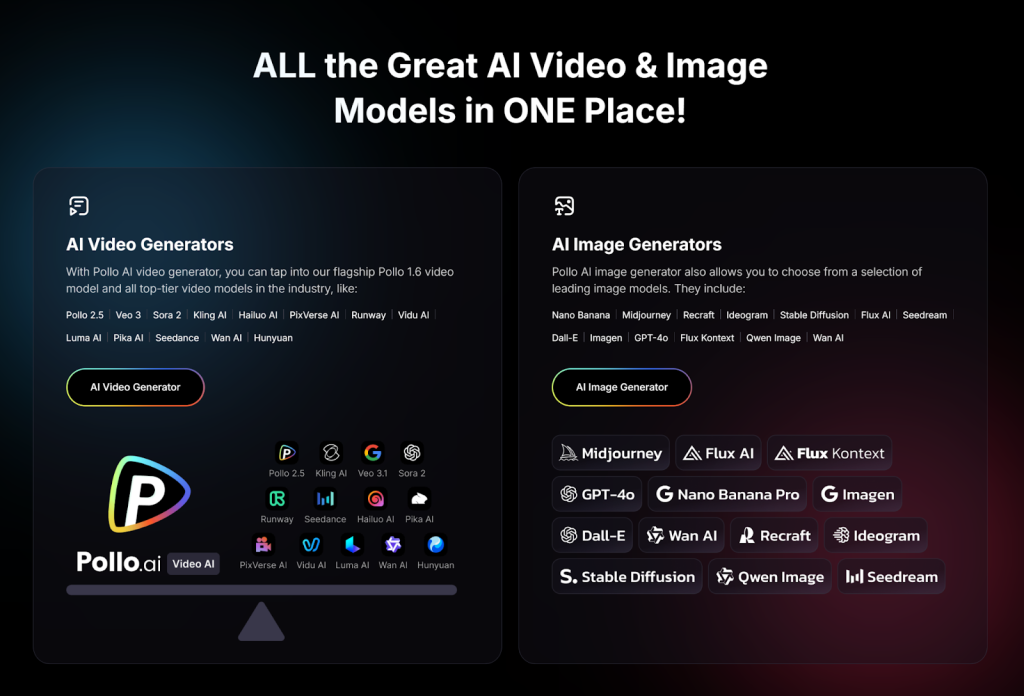
This is where Pollo AI becomes a game-changer for motion designers. Instead of juggling separate subscriptions to Kling, Runway, Luma, and others, Pollo AI aggregates access to leading models including Pollo 2.5, Veo 3.1, Sora 2, Kling AI, Luma AI, and PixVerse—all within a single interface. For animators, this means testing the same prompt across different visual styles without switching between expensive tools.
Pollo’s AI animation generator aligns perfectly with modern motion design needs. Text-to-video and image-to-video generation transform concepts into moving visuals instantly. “Reference to video” tools help maintain character consistency across scenes—crucial for narrative animation.
Available on both web and video creator app, Pollo AI puts professional-grade animation tools in creators’ pockets. With pricing starting at $15/month, it offers a cost-effective entry into AI-powered motion design.
What AI Gets Right—And Where It Still Needs You
AI excels in three domains: repetition reduction, motion scaffolding, and physically plausible interpolation. It can analyze reference video to suggest keyframe positions and predict natural easing between sparse keys.
But here’s the critical insight: AI excels at solving constraints, not intentions. It reduces the labor of hitting physically plausible ranges but cannot decide whether a character should hesitate for 8 frames or 12 before speaking. Those are dramaturgical choices rooted in script and directorial vision—not statistical likelihoods.
As one lead animator put it: “AI doesn’t replace expressive control—it relocates the locus of control. You trade frame-level precision for higher-level direction. But if you don’t know how to articulate that direction, the AI becomes a black box”.

The Hybrid Workflow
The most expressive animators aren’t choosing between AI and manual methods—they’re mastering both as complementary languages. Consider a real-world comparison: animating a three-second shot of a character pouring coffee while showing mild exhaustion.
The manual approach takes about four hours. The AI-assisted approach takes about 2.5 hours. The animator records rough reference video, imports it into AI tools to generate base keyframes, then manually edits 70% of the generated keys—shifting timing, adding asymmetry, deleting AI-suggested movements that felt too fluid. The result achieves the same emotional clarity with 35% less repetitive labor.
What’s Next
The future of motion design isn’t about choosing a single tool or workflow. Traditional editing still excels at bespoke work. AI video generators are useful for fast ideation. AI motion graphics fills the gap for scalable, consistent production.
The question is no longer whether keyframes will disappear. They won’t—not entirely. But the days of adjusting Bezier handles for eight hours straight are numbered. The future belongs to animators who can think in systems, who can articulate creative direction in natural language, and who treat AI suggestions as drafts rather than final products.
The craft of motion design isn’t dying. It’s evolving. And the animators who evolve with it will find themselves designing not just individual animations, but the systems that generate them.
More to Love!
The Best Art and Design Schools in the World
The Future of Interior Design: AI and 3D Rendering Innovations