SUBSCRIBE


Powerful Women of Ancient History
Our world today is vastly different from that of antiquity, and yet many things such as love, fear, and power structures remain surprisingly similar to how they were in the past. The women who previously lived, wrote, and ruled faced many challenges, and by looking at what we know of their experiences we can reflect better on our own world and appreciate the common experiences as well as the differences. Read on for examples of powerful women of ancient history! And be sure to take note of the lessons we think can be learned from them.
Example #1: Hatshepsut
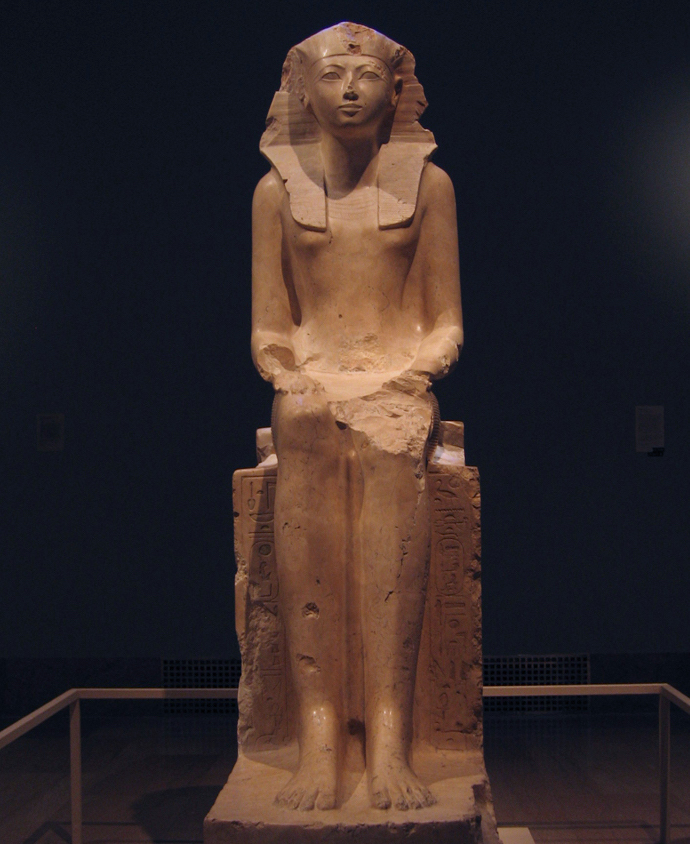
Hatshepsut was the daughter of a Pharaoh. She went on to become Queen of Egypt when her father died and married her brother, the new Pharaoh of Egypt. Upon his death, due to their lack of children, she co-ruled as Pharaoh with her child nephew although her bloodline was ‘purer.’ She was a wildly successful Pharaoh who enriched Egypt and an avid builder of obelisks and monuments. She began to display herself as a man in public images to maintain the male standard expected of a Pharaoh.
After her death, her nephew became sole Pharaoh and systematically tried to erase her legacy from monuments while ensuring no women around him had powerful positions, both in his lifetime and thereafter. Due to the erasing of her legacy, historian’s did not understand her significance as one of the powerful women of ancient history for a long time.
The Lesson
To rule in a man’s world, you will have to work harder than a man would have to. Her name may have been effaced from many of her monuments but not all of them, because she was such a prolific builder, and in time the truth was revealed.
Example #2: Sappho
Sappho was regarded as one of the greatest lyricists of her time and called “The Poetess” by Plato. Although only one twenty-eight-line poem of hers has survived the 2,500 years since she lived – entitled, “Ode to Aphrodite,” you may recognize what she has contributed to language. Born on the Greek island of Lesbos, records indicate she opened a school for unmarried women dedicated to Aphrodite and Eros. After her death, she was parodied for being a promiscuous lesbian, which is where the words sapphic and lesbian come from. The “Sapphic meter” in poetry relates to her name.
The Lesson
Sappho celebrated women and although she was parodied after her death, she left some of her own words for antiquity – literally and figuratively. Surely one of the women of ancient history never to be forgotten.

Example #3: Cleopatra VII
Cleopatra VII lived a life more dramatic than a telenovela. Born into the Ptolemaic dynasty as the daughter of a Pharaoh, she was trained to rule by her father who later executed her older sister for taking his place on the throne when he was forced to flee. Cleopatra went on to marry her younger brother and become both Queen and co-ruler of Egypt with him.
According to Plutarch, she was a polyglot fluent in many languages, and she won the heart of Caesar, who helped her in a war against her brother, in which her brother was killed. Legend has it she first had herself delivered to Caesar rolled up in a rug. Caesar also likely fathered her son, Caesarean, who became her infant co-ruler after Caesar was murdered and after her second brother was assassinated, who had become her co-ruler after her first brother’s death.
Thereafter, Cleopatra began an affair with Marc Antony, with whom she had three children and with whom she went to war against Octavian, a war they ultimately lost. Marc Antony committed suicide after receiving false news that Cleopatra was dead, and Cleopatra committed suicide after burying him. Octavian went on to influence the history written about her, emphasizing her beauty, seductiveness, and skills in the dark arts while downplaying her intelligence, wit and leadership skills. Cleopatra’s tomb has never been found.
The Lesson
Blood may be thicker than wine, but sometimes it is less attractive than power. History as we know it was written by the winners…usually men. And yet, no amount of rewriting can erase her impact on the Ancient world.
.png)
More to Love: How to Be a Powerful Woman
Example #4: Wu Zetian
Wu Zetian was the only female emperor in Chinese history. Some call her brilliant, others call her brutal. Wu was not born into royalty, she came from a merchant family and was chosen by the Emperor to be a member of his concubine. It was common at the time for Emperors to have a large concubine in addition to the Empress consort, to ensure the births of as many male heirs as possible onto whom the crown could be passed.
Wu did not give birth to any sons, and upon the Emperor’s death, she was placed in a convent following the custom at the time. Wu somehow escaped from the convent and became the consort of the next Emperor, Emperor Gaozong. She gave birth to a baby girl who was strangled to death – some believe by her herself. Wu accused the Empress of the murder, who was removed from her position as Empress because of this, a position that Wu then stepped into. She then gave birth to a son, who was named as heir to the throne.
The Emperor fell ill and although her first son was exiled, upon the Emperor’s death another of her sons took the throne and she became the regent. When she had disagreements with this son, she had him deposed and replaced him with one of his younger brothers, who was very young and never even officially appeared at court. He was forced to abdicate the throne to her in 690 C.E. at which point she became sole ruler and Empress.
During her reign, she expanded China’s empire, reformed agricultural production and tax systems, reopened the Silk Road and supported Buddhism. Shortly before her death in 705 C.E., one of her rivals forced her to abdicate the throne, thus ending the Zhou dynasty. After her death, the slab erected in front of her tomb, as was customary for emperors, instead of being filled in with her accomplishments, hers was left blank.
The Lesson
Well-behaved women rarely make it in history, ancient or not. Wu has become a popular albeit controversial figure in modern China and inspired books, TV shows, and movies. The face of the largest Buddha statue in the world is supposedly based on her face, where she gazes out at the world from the Longmen Grottoes in the Henan province.

More to Love: 12 Strong Women Leaders to Know
Example #5: Razia Sultana
Razia Sultana was the first and only female ruler of the Sultan of Delhi in northern India. As the most ‘modern’ woman on this list, ruling from 1236 to 1240, Razia rose to power despite her ancestors having been slaves. Her father Iltutmish had originally come to Delhi as a slave of the ruler Qutb-ud-din and had risen to the rank of provincial governor by impressing the ruler with his hard work. He eventually married Qutb-ud-din’s daughter and upon Qutb-ud-din’s death, Iltutmish became the Sultan with the backing of the Turkish nobility. He then appointed his daughter as his heir apparent – the first time a woman was named by a Sultan as their successor.
Razia had been trained in politics, martial arts and administration like her brothers, but unlike them, she was hardworking and highly competent. After her father’s death, her brother usurped the throne from her and she only became Sultan after his death by assassination.
Also known as Raziya al-Din, she was the first Muslim female ruler. She began to wear more masculine clothing and stopped wearing the veil after her ascent as Sultan. She was a beloved and fair ruler, she led battles that expanded her territories and supported academies and libraries where ancient philosophers, Hindu teachings and the Quran were studied, before her reign ended with her death during conflict.
The Turkish nobility had taken offense to have a woman as a ruler, and especially a woman suspected of having a relationship with an Assyrian slave, and raised an army against her. She went to fight the revolt and was taken prisoner, before winning the heart of her captor Altunia who married her. He, in turn, joined her to fight against her brother where they were both defeated and killed during the fighting, and her other brother was placed on the throne.
The Lesson
Hard work and judiciousness can be more important than lineage. Beware the sleeping giant, even when it is your family. When her brothers wanted to take the crown that was rightfully hers, sentiment did not stop them. Nevertheless, it is she who became much more famous after death and now reigns in the list of women in ancient history to note!

Example #6: Kubaba
Kubaba is not only the first known female king, but her reign began after her career as a bartender. Also known as Kug-Bau, she ruled over ancient Sumer, which was at the time – 4,500 years ago – the largest civilization in Ancient Mesopotamia. On the official Sumerian King List, which is a clay tablet listing all Sumerian kings and years of their reigns, she is described as, “the woman tavern-keeper.” She is also described as having ruled for over 100 years, which was most likely an exaggeration, but the tablet is a mixture of myth and historical fact.
It is not recorded how she transitioned from tavern-keeping to Queen, but tavern-keeping was considered an important and highly respectable position at that time. Kingship was passed from city to city in ancient Sumer, and it was in the city of Kish that Kubaba ruled, where it is recorded that she fortified the foundations of the city.
When her reign ended, the city of Akshak took over the kingship, but Kubaba soon won back the God’s favor for her family. The Babylonian text the Weidner Chronicle says, “Kubaba gave bread to the fisherman and gave water, she made him offer the fish to Esagila. Marduk, the king, the prince of the Apsû, favored her and said: “Let it be so!” He entrusted to Kubaba, the tavern-keeper, sovereignty over the whole world.” And after that, power returned to Kish under the King Puzur-Nirah, who was the son of Kubaba. He, in turn, passed the rulership onto his son before their family ceased to rule.
The Lesson
It appears Kubaba was selected as King because of her abilities and qualities, not because of her pedigree. One need not be high-born to possess the traits of a great leader and indeed, become like Kubaba, the leader of what was then the most powerful civilization in the world.

Words by Caitlin Arnould, Host of the Beauty Is Eternal podcast.
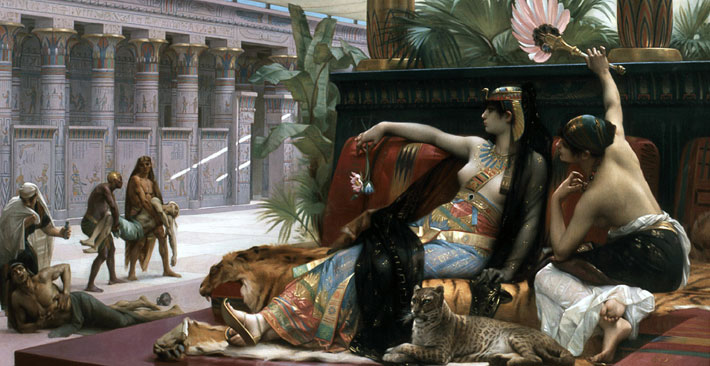
Feature Image: Cleopatra Testing Poisons on Condemned Prisoners, 1887 by Alexandre Cabanel
Did we miss one of your favorite powerful women in ancient history? Tell us who in the comments below!