SUBSCRIBE


How 3D Rendering Helps Secure Funding for Luxury Interior Projects
Before a single slab of marble is sourced or a piece of custom millwork commissioned, a luxury interior project has to clear one decisive hurdle: getting the people with the money to believe in it.
That’s harder than it sounds. Mood boards and 2D floor plans can communicate a direction, but they rarely communicate a feeling. And in high-end development, feeling is everything — it’s what justifies the budget, builds excitement in a boardroom, and ultimately gets the project greenlit.
This is why serious teams are increasingly treating 3D visualization not as a finishing touch, but as a core part of how they raise capital. When you’re pitching a $3 million penthouse interior or a branded resort, showing is simply more convincing than telling.
The Problem with Asking People to Imagine It
High-net-worth investors and private clients are sophisticated. They’ve seen enough projects to know that a beautiful concept can fall apart in execution — and they’ve learned to be cautious. Before they commit, they want something closer to certainty.
The challenge is that luxury interiors are inherently complex. It’s not just the layout that matters — it’s the way afternoon light hits an imported stone countertop, how a brass fixture reads against dark walnut millwork, whether a custom sofa actually fits the proportions of the room it was designed for. These things are nearly impossible to convey through descriptions or sketches.
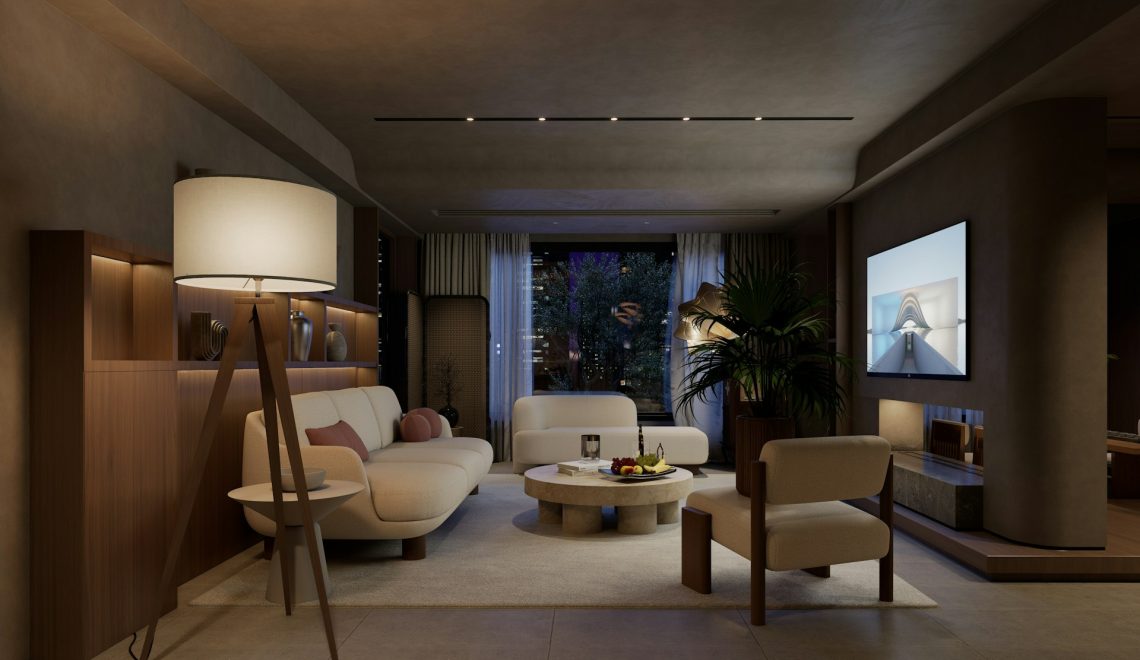
Photorealistic 3D renders close that gap. When investors can see the veining in the marble, the depth of the upholstery, the way evening light moves through a double-height space — the conversation shifts. They’re no longer evaluating a concept. They’re evaluating a finished space.
What Changes When You Show the Full Picture
For large residential developments, interiors are often what separates one project from another in a crowded market. Buyers don’t fall in love with square footage — they fall in love with the way a space makes them feel. So when developers go into funding meetings, their interior vision needs to do real work.
That means going beyond individual room renders. Positioning a building within its actual environment — its neighborhood context, its relationship to the skyline, its footprint on the land — is where aerial rendering earns its place in the pitch. A precisely rendered bird’s-eye view of a luxury tower, a coastal resort, or a hillside villa development gives investors something they can immediately grasp: scale, prestige, location. It answers the question “does this belong here?” before anyone has to ask it.
Combined with detailed interior renders, this kind of full-picture visualization changes the dynamic of a funding conversation. The project stops feeling theoretical and starts feeling inevitable.
Protecting the Budget Before Ground Breaks
There’s a practical argument for visualization that gets less attention than the emotional one: it catches expensive mistakes before they happen.
Luxury construction doesn’t forgive mid-project changes easily. Swapping out cladding after materials have been ordered, reworking cabinetry after installation, rethinking a lighting plan once the ceiling is closed — each of these corrections costs time and serious money. When clients and stakeholders can review a fully rendered interior before anything is built, disagreements surface early, when fixing them costs nothing.
This is something experienced investors understand and value. A team that comes to the table with high-quality visualization isn’t just showing off — they’re demonstrating that the project has been thought through. That kind of preparation reads as competence, and competence makes funding feel less risky.

The Emotional Logic of Luxury
It would be a mistake to treat the emotional side of these pitches as secondary. In luxury markets, feeling and logic are equally persuasive — sometimes feeling wins.
A boutique hotel isn’t selling a room. It’s selling an experience. A branded residence isn’t selling square meters. It’s selling a version of a life someone wants to live. When the render shows a candlelit lounge with the right textures and the right shadows, or a primary suite that radiates calm and exclusivity, it triggers something that a spreadsheet can’t reach.
This matters for private clients as much as for institutional investors. When someone is spending millions on a bespoke home, what they need most is confidence — not in the numbers, but in the vision. Seeing their staircase, their terrace, their dining room rendered in full before a wall goes up eliminates the doubt that slows decisions down.
When Everyone Needs to Agree
Luxury projects rarely have a single decision-maker. Developers, designers, brand consultants, investors, and operators all have stakes, and getting them aligned is often harder than the design work itself.
This is where shared visual references become genuinely useful. When every stakeholder is looking at the same photorealistic image — not interpreting the same set of notes — feedback gets specific fast. “Does this feel consistent with our brand?” is a much easier question to answer when you’re looking at a rendered lobby rather than a mood board. Faster alignment means fewer revision cycles, shorter approval timelines, and projects that actually move forward.
Presentation Quality Reflects Project Quality
There’s one more thing worth saying: in luxury markets, how you present something signals what you think of it.
Teams that show up with polished, high-resolution renders — interior walkthroughs, exterior perspectives, aerial context shots — communicate that this project is being taken seriously. That the attention to detail in the presentation reflects the attention to detail that will go into the build. Investors and clients pick up on that. Vague, unresolved presentations raise unspoken questions about what else might be unresolved.
Visualization, done well, answers those questions before they’re asked. It turns a pitch into a preview — and in luxury interiors, that’s often exactly the difference between interest and commitment.
More to Love!
The New Digital Craft: How 3D Modeling Services Empower Women in Design
The Future of Interior Design: AI and 3D Rendering Innovations